
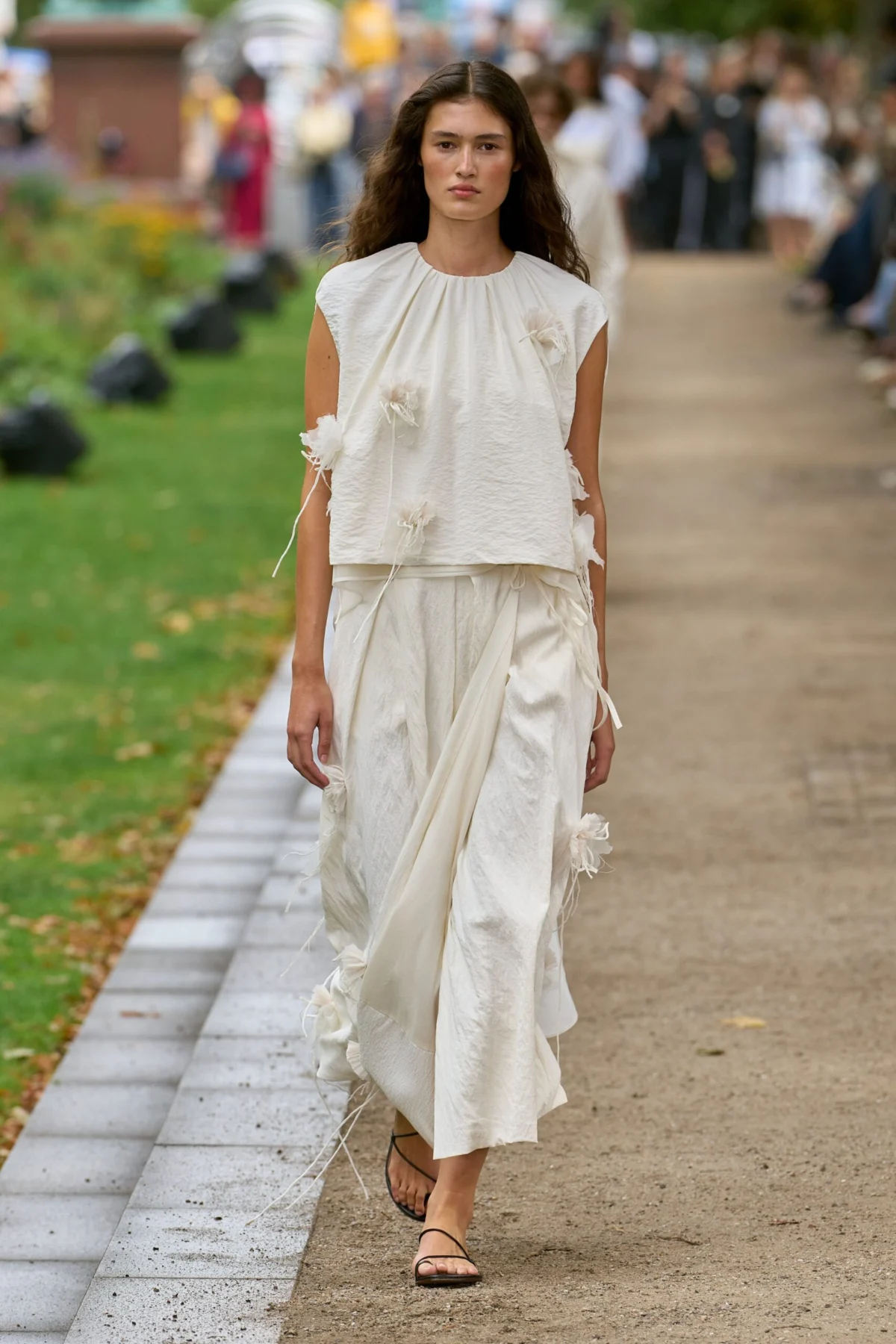
The Copenhagen fashion landscape has long established itself as a global epicenter for pragmatic luxury, a reputation further solidified by the latest showcase from MKDT Studio. Under the creative direction of Caroline Engelgaar, the brand’s Spring Summer 2025 collection serves as a testament to the "decidedly wearable" ethos that distinguishes the Danish capital from the experimentalism of London or the high-octane theatricality of Paris. Rather than pursuing the industry’s traditional cycle of radical seasonal reinvention, Engelgaar continues to champion an iterative design philosophy, viewing each collection as a subsequent chapter in an ongoing conversation about the modern woman’s wardrobe.
The Philosophical Foundation of Iterative Design
The core of MKDT Studio’s identity lies in the rejection of "disposable" fashion trends. Creative director Caroline Engelgaar has consistently emphasized that the brand’s objective is to build a cohesive, evolving wardrobe. This approach aligns with broader consumer shifts toward longevity and "quiet luxury," where value is derived from material quality and versatility rather than overt branding. By focusing on iterations rather than distinct, disconnected collections, MKDT Studio ensures that a piece purchased three seasons ago remains relevant when paired with the latest offerings.
This philosophy is particularly resonant in the current economic climate. According to data from the Danish Fashion & Textile (DM&T) association, the Danish fashion industry has seen a significant emphasis on sustainable growth and export, with a turnover reaching approximately 32 billion DKK in recent years. The success of brands like MKDT is often attributed to this "Scandi-cool" sensibility—clothes that are sophisticated enough for the office but functional enough for the bicycle-heavy commutes of Copenhagen.
Artistic Duality: The Influence of Hammershøi and Klein
For the Spring Summer 2025 season, Engelgaar drew inspiration from the works of two contrasting Danish artists: the early 20th-century painter Vilhelm Hammershøi and the contemporary photographer Kirsten Klein. This dual inspiration allowed the collection to explore the "duality of womanhood," a thematic journey navigating the space between "wildness and calm."
Vilhelm Hammershøi is renowned for his muted palettes and his focus on interiors, often depicting subjects from the back in moments of quiet contemplation. Engelgaar translated this "sense of serenity" into the collection’s primary silhouettes and its restrained black and white color palette. The influence of Hammershøi was most evident in the structural details that prioritized the rear view of the garment. For instance, a structured camisole was designed to cascade elegantly toward the ankle, while a loose linen blazer featured a meticulous line of buttons punctuating the spine, transforming the back of the wearer into a focal point of artistic interest.
In stark contrast, the influence of Kirsten Klein brought a sense of untamed energy to the collection. Klein’s photography often captures the raw, windswept landscapes of the Danish coast, where nature refuses to be confined. Engelgaar channeled this into pieces that suggested a woman in motion—someone who "cannot be boxed in." This was achieved through the use of translucent jackets and double-layered dresses that created a "sheer shadow" around the silhouette, mimicking the hazy, atmospheric quality of Klein’s landscape work.
Materiality and Collaborative Craftsmanship
The collection’s technical execution was bolstered by several key collaborations, a hallmark of Engelgaar’s commitment to artisanal quality. Visual creative Cecilie Ellerup worked with the studio to develop blurred floral prints that appeared to "sprint" across the fabric, capturing the essence of movement. These prints served as a bridge between the stillness of Hammershøi and the dynamism of the modern urban environment.
Furthermore, the collection featured intricate floral appliqués by embroidery artisan Thit Moses. These details were described as "at once dainty and spindly," designed to look as if they were alive and bursting forth from the seams. To further evoke the feeling of wind whipping across open plains—a direct nod to Klein’s photography—Engelgaar incorporated full fringe on skirts and dresses. These elements were engineered to dance with every step, ensuring that the garments remained as dynamic as the women wearing them.
The Urban Stage: Integration of Venue and Environment
The presentation of the collection was as much about the environment as it was about the clothes. Departing from the grand, often detached locations typical of major fashion weeks, MKDT Studio chose a setting that mirrored the everyday lives of its clientele. The show took place in the vicinity of the brand’s Nyhavn store, with seating spilling out onto the sidewalks of the tree-lined Sankt Annæ Plads.
The choice of location was deeply symbolic; Vilhelm Hammershøi’s former home was visible in the distance, anchoring the collection’s historical inspirations in a physical reality. The atmosphere was inadvertently enhanced by a light summer rain, which Engelgaar noted added to the feeling of "women passing through the city." The styling further emphasized this urban realism, with models carrying organza shopping bags containing AirPods and flowers slung underarm, portraying a vision of luxury that is integrated into the mundane tasks of city life.
"It’s not as grand as our usual locations, but it’s extremely beautiful," Engelgaar remarked regarding the choice of Sankt Annæ Plads. "You get to see the way women walk, the way they sit, the way they move through the city. The everyday setting becomes the stage."
Economic Context and the Global Appeal of Copenhagen Fashion Week
The MKDT Studio show occurs at a pivotal moment for Copenhagen Fashion Week (CPHFW). Once a regional event, CPHFW has grown into the fifth most influential fashion week globally, largely due to its stringent sustainability requirements. Since 2023, all participating brands must meet 18 minimum sustainability standards, covering everything from the ban on destroying unsold clothes to ensuring at least 50% of the collection is made from certified, recycled, or upcycled materials.
MKDT Studio’s focus on the "wardrobe" concept aligns perfectly with these industry-wide mandates. By encouraging consumers to buy fewer, higher-quality items that work across seasons, the brand positions itself at the forefront of the "slow fashion" movement. Market analysts suggest that this strategy is particularly effective for capturing the "aspirational professional" demographic—consumers who are increasingly wary of fast-fashion cycles and are looking for investment pieces.
Strategic Implications and Industry Reception
The reception of the Spring Summer 2025 collection among buyers and critics has been overwhelmingly positive, particularly regarding the brand’s ability to balance artistic depth with commercial viability. Retailers have noted that the "back-centric" details of the blazers and camisoles provide a unique selling point in a crowded market of minimalist basics.
The logistical decision to use the Nyhavn store as the backstage area and the public square as the runway also reflects a broader trend in the industry: the desire for authenticity. In an era where fashion shows are often criticized for being overly produced and disconnected from reality, MKDT’s "street-level" approach offers a refreshing transparency. It suggests that the clothes are not just for the runway, but for the actual streets of Copenhagen, Oslo, London, and New York.
Conclusion: The Future of MKDT Studio
As MKDT Studio continues to refine its iterative design model, the brand is carving out a distinct niche within the global fashion hierarchy. By leaning into the duality of the Danish identity—the quiet, interior-focused contemplation of the past and the wild, untamed movement of the present—Caroline Engelgaar has created a collection that feels both timeless and urgently contemporary.
The Spring Summer 2025 collection serves as a reminder that the most powerful fashion often comes from a place of restraint and deep observation. As the MKDT woman moves through the city, AirPods in hand and fringe dancing in the rain, she represents a modern ideal: a woman who is grounded in her history but moving decisively toward the future. For MKDT Studio, the path forward is clear: continue building, continue iterating, and never lose sight of the woman in motion.

0 Comments