
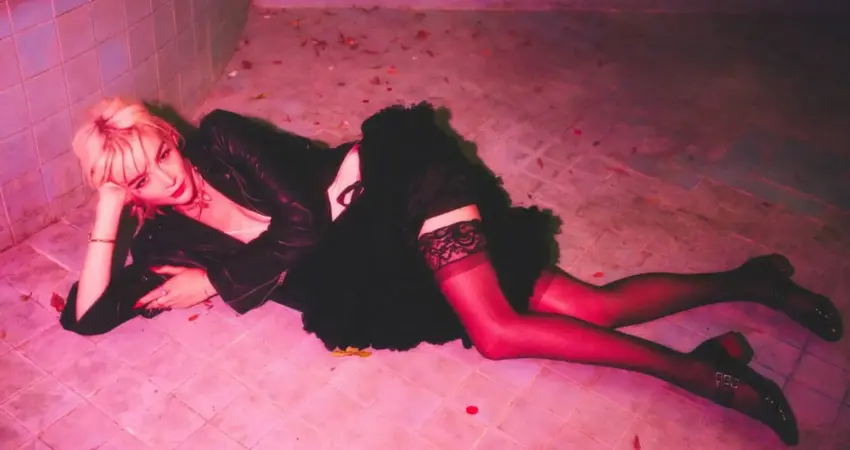
At the heart of a bustling Los Angeles household, where Italian film scores might seamlessly transition into disco beats and three-year-old twins dance freely, resides Allie Teilz, a renowned vinyl DJ and producer whose recent debut album, Come to Mommy, offers a profound meditation on motherhood, identity, and creative resurgence. Released on October 23, 2026, the album is more than a collection of atmospheric, danceable electronic tracks; it is a powerful manifesto that challenges conventional narratives surrounding maternal self-sacrifice, asserting that becoming a parent can expand, rather than diminish, a woman’s artistic and personal self.

From Los Angeles Nightlife to Intentional Motherhood
Allie Teilz carved a significant niche in the vibrant Los Angeles nightlife scene, sharing booths and collaborating with iconic figures like Grace Jones and Daft Punk. Her early career was characterized by a deep engagement with music and a dynamic presence in a competitive industry. However, her life took a transformative turn with the arrival of her four children, including a set of three-year-old twins and an almost eight-year-old. This shift, far from leading her away from her artistic calling, redirected and deepened it.

Teilz now describes her home as a "90s-electronics household," a deliberate choice to curate an environment steeped in analogue experiences. Phones are deposited in a ceramic cow during dinner, while a projector, a record player, and a wall of VHS tapes featuring classics like Yellow Submarine and The Land Before Time foster a rich, sensory, and screen-limited childhood for her children. This intentional approach to parenting mirrors her artistic philosophy: a refusal to conform to prevailing trends and a commitment to authentic, meaningful engagement. Despite her impressive resume, Teilz unequivocally states, “I am a mother first and an artist second,” a declaration that speaks volumes about her integrated identity.

Come to Mommy: A Sonic Reclamation of Self
The release of Come to Mommy marks a pivotal moment in Teilz’s career, signifying her triumphant return to her artistic core after navigating the profound changes of motherhood. The album’s sound is a sophisticated blend of atmospheric textures, irresistible rhythms, and an electronic sensibility that manages to feel both nostalgic and forward-thinking. Its title, a provocative inversion of the patriarchal phrase "come to daddy," encapsulates the album’s central theme. Teilz explicitly poses the question, "What Mommy wants?" and answers it with unreserved clarity: "Mommy wants joy. She wants to have fun and dance. She wants pleasure and joy." This statement is not merely a personal wish but a defiant assertion against societal expectations that often demand mothers sublimate their desires for the sake of their families.

The album serves as a sonic journey through her experiences, from the challenges of adapting to motherhood to the profound insights gained. Each track contributes to a larger narrative of resilience and self-discovery, inviting listeners—especially mothers—to embrace their multifaceted identities without compromise. Early reception suggests the album resonates deeply with audiences, particularly those who have felt the squeeze of societal pressures to shrink their personal aspirations post-parenthood. Music critics have lauded its innovative sound and powerful message, noting its potential to inspire a re-evaluation of the role of women in the arts and beyond.

Motherhood as an Expansive Creative Force
Contrary to the common narrative that motherhood can truncate or sideline a woman’s artistic career, Teilz posits that it has been a catalyst for deeper creativity. “Becoming their mom,” she reflects, “only made everything bigger, not smaller.” This perspective directly challenges the "motherhood penalty" often observed in various professional fields, where women experience career stagnation or decline after having children. For Teilz, the constraints of limited time inherent in parenting became a crucible for heightened focus and clarity. “The deepest creativity can come from having very little time and knowing exactly what matters,” she observes, suggesting that necessity can be the mother of invention in the most literal sense.

She describes the act of becoming a parent as a "surrender," a profound handing over of one’s soul to guide another life, yet paradoxically, this surrender "cracked the work open instead of closing it down." It "liberated me in creation," she states, providing her with "a deeper well to pull from." This transformation led her to view motherhood itself as “the highest form of art I’ve ever experienced.” This reframing not only elevates the act of parenting but also validates the creative depths it can unlock for artists.

This newfound perspective has also reshaped the very nature of her artistic output. Teilz now filters her work through her children’s eyes, guided by a singular question: "What do I want to see more of in the world?" Her answer is a rejection of what she terms “AI art and lobotomy chic”—a critique of soulless, machine-driven creative endeavors—in favor of fostering a "beautiful state of play." She yearns for her children to experience the unbridled joy and freedom she felt upon first hearing bands like Talking Heads, embodying the playful spirit of David Byrne’s giant suit. Her album, Come to Mommy, is a deliberate effort to reintroduce this sense of joyous abandon into the world, an endeavor for which she credits her children as her primary inspiration and "greatest teachers."

Unpacking Societal Pressures and Embracing Boundaries
Teilz’s journey is a powerful counter-narrative to the pervasive societal expectation for women to diminish their individual selves upon becoming mothers. Many women intimately understand the "shift that happens when you become a mother," where the "self gets smaller to make room for everyone else." Teilz herself experienced this gravitational pull towards a form of motherhood where women "vanish into" their roles, observing mom groups characterized by endless giving and neglected personal needs, and careers set aside, never to be resumed. The insidious question, “Who am I?” often lingers unanswered.

She incisively points to cultural touchstones like The Giving Tree and The Rainbow Fish as "dangerous" narratives that subtly indoctrinate children and, by extension, mothers, into believing that "self-erasure is generosity." The messages—"Make yourself a stump and you’ll be loved," "Give away your sparkles and you’ll be accepted"—are, in Teilz’s view, profoundly detrimental. This critique highlights a broader societal issue where maternal identity is often conflated with boundless selflessness, leaving little room for personal ambition or well-being.

Teilz’s path back to her authentic self was paved with the establishment of firm boundaries. A key tool in this reclamation was a flip phone, used during designated hours when she deliberately chooses to be unreachable, carving out essential space for herself. This pragmatic approach was prompted by a stark realization: "have boundaries or get an autoimmune disorder," a line she encountered that resonated deeply as her own health began to suffer. Her epiphany was clear: “My kids don’t need a mom who disappears into anything, even motherhood.” This statement is a clarion call for mothers to prioritize their own well-being, not as a luxury, but as a fundamental necessity for holistic family health.

Cultivating a Childhood of Wonder and Resilience
Allie Teilz approaches the creation of her children’s environment with the same meticulous artistry she applies to her music, weaving together specific, deliberate, and slightly magical details. This intentionality is evident in stories like her daughter’s "leader award" celebration, which involved crafting "ice cream mountains"—scoops stacked into castles on parchment paper, reminiscent of a beloved childhood shop. These moments, whimsical for their own sake, underscore Teilz’s belief that the most cherished memories are often found not in grand gestures but in the small, imaginative details of daily life. She contrasts this with her own childhood memories, prioritizing the simple joy of choosing ice cream before the first day of school over elaborate trips.

Her parenting philosophy also emphasizes cultivating a profound sense of wonder and connection to the natural world. Her children are encouraged to participate in dinner preparation by harvesting parsley or tomatoes from the garden, learning to grow things "from seed to fruition." Watching a baby artichoke emerge from a watered seed becomes a "small miracle" she wants them to appreciate. Books hold a similar reverence; Teilz recalls an indelible image of a mother and daughter reading together on a subway, and now, one of her proudest moments is witnessing her own daughter engrossed in Harry Potter. Her advice to other mothers is simple yet profound: “Stay curious about the world. Keep reading. Stay interested in what matters to you.” This encourages a continuous personal growth that enriches both the mother and the environment she creates for her children.

The journey to this state of integrated joy and artistic output was not without immense struggle. Come to Mommy was forged during a "brutal stretch" in Teilz’s life, including a traumatic birth experience that nearly claimed both her life and that of one of her sons. The album’s final track, "Back From the Dead," is a deeply personal testament to this ordeal, written specifically for the twin she almost lost. This track, and indeed the entire album, serves as her way of conveying to all her children that "they can come back from the worst thing." Making art from this profound adversity became a therapeutic process, offering "proof to her children that you can take something that breaks you and make something beautiful out of the ashes." It is a powerful narrative of post-traumatic growth, demonstrating how profound pain can be transmuted into inspiring creation.

A Call to Reclamation: Stealing Your Own Fire
When asked to envision a mother pulling into her driveway, listening to Come to Mommy and pausing before entering her home, Allie Teilz articulated a clear and resonant message. She wants that woman to "steal the fire" of her own passion, to recall the song she danced hardest to at her 13th birthday, to feel held, and to find a reason to dance. Above all, Teilz hopes her music helps that woman "feel more like herself."

This vision encapsulates the album’s broader cultural significance. In a society that often implicitly or explicitly tells women that their individual selves must shrink to accommodate motherhood, Allie Teilz offers a resounding counter-argument through her art and her life. Her debut album is not just a musical offering but a profound statement—a vibrant, undeniable affirmation that a mother’s identity can expand, deepen, and flourish in new and powerful ways. It is an invitation for every mother to reclaim her joy, her pleasure, and her uncompromised self, proving that the self does not have to shrink to make room for mothering; it can, in fact, become bigger.

0 Comments