
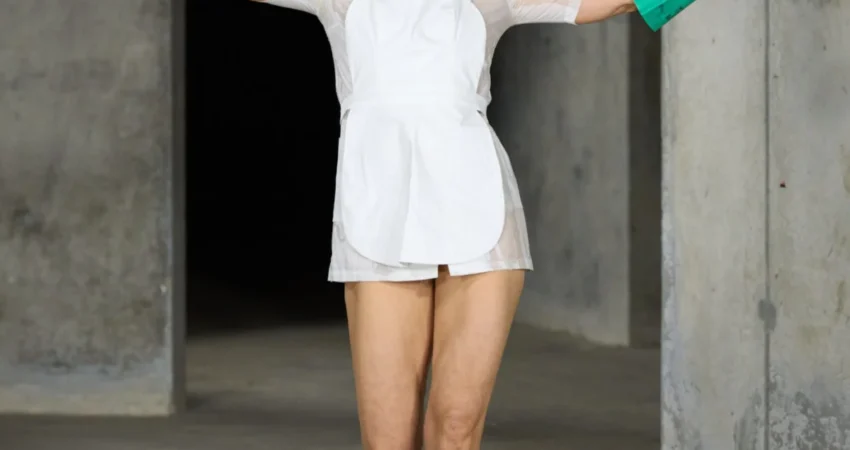
London-based designer Natasha Zinko has unveiled her Spring 2027 collection, titled "Pay Per View," a provocative exploration of surveillance, social media performance, and the monetization of the private self. Staged in an underground brutalist theater in London, the presentation moved beyond a traditional runway format, instead utilizing a circular "panopticon" arrangement to critique the modern experience of being "constantly perceived." The collection arrives at a pivotal moment for the Zinko brand, which continues to distinguish itself through a rare in-house production model where patterns are cut and garments are assembled within her West London atelier. This proximity to the craft allowed for a highly technical display of satin, leather, and bonded fabrics, even as the conceptual framework delved into the "slippery, sensual business" of life under the digital lens.
Conceptual Framework: From Bentham to the Digital Age
The "Pay Per View" collection is rooted in a deep engagement with 18th-century architectural theory and 20th-century philosophy. Zinko cited the work of Michel Foucault, specifically his analysis of Jeremy Bentham’s "panopticon"—a prison design where a single central observer can watch all inmates, who never know exactly when they are being monitored. According to Foucault, this uncertainty forces individuals to internalize the gaze and regulate their own behavior, a phenomenon Zinko argues has become the standard for modern existence in the era of live-streaming and algorithmic social media.
In the designer’s view, the digital landscape has transformed society into a global panopticon where the "guard" is the collective audience and the "inmates" are the users. The Spring 2027 collection serves as a satirical yet serious commentary on how individuals perform "sexiness" or "professionalism" when they assume they are being watched. By literalizing this idea, Zinko transitioned from archetypal role-play—such as the nurse, the policeman, and the maid—to a more abstract representation of the "perceived self."
Chronology and Event Logistics
The development of the Spring 2027 collection began in Zinko’s West London studio several months prior to the show. Unlike many contemporary designers who outsource manufacturing to specialized factories in Italy or Portugal, Zinko maintains a full-scale factory and atelier in-house. This allowed for a rapid prototyping process, where garments were tailored specifically for a high-profile cast that included musicians, artists, and cult figures.
On the evening of the show, guests were ushered into a subterranean brutalist space arranged "in the round." The traditional linear runway was replaced by a two-story structure featuring individual windows or "cells." The chronology of the performance was dictated by a capricious lighting scheme; windows were illuminated one at a time, forcing the audience to physically turn and scan the room to locate the performer. This intentional disorientation was designed to mimic the rapid-fire consumption of content on social media platforms.
The cast was a deliberate cross-section of British and international cultural icons. Participants included Kelly Osbourne, Faris Badwan of the Horrors, and former glamour model Katie Price. Each performer was tasked with bringing a personal prop and improvising a routine once their "cell" was lit. For instance, Badwan utilized a laser pointer to interact with the shadows of the concrete theater, while Osbourne, dressed in a subversive maid’s uniform, incorporated an heirloom bat ornament. This blur between the designer’s characterization and the performer’s personal brand was central to the show’s thesis on the "slippery" nature of identity.
Materiality and Technical Execution
Technically, the Spring 2027 collection showcased Zinko’s evolution in textile manipulation. The designer utilized satin and silks for their reflective qualities, enhancing the "performative" nature of the garments under harsh spotlighting. A notable technical feat involved the use of bonded fabrics that achieved a "papery stiffness," allowing for corseted pieces to be padded into organic, bulbous forms around the hips. This silhouette served to distort the human frame, suggesting a body that has been surgically or digitally altered for the camera.
The collection’s color palette was dominated by "fleshy" tan leathers, hot pinks, and clinical whites. One standout piece was a pink rose-adorned mini-dress, which Zinko developed after observing the aesthetic of wilting flowers in her own home. The garment, which had already gained traction after appearing in Charli XCX’s "Wink Wink" music video, represented the intersection of high fashion and viral pop-culture moments.
Specific design motifs reinforced the theme of monetization:
- The "Navel" Purse: A tan leather skirt featured a small coin purse positioned directly over the navel, a literal nod to the "paying" aspect of "Pay Per View."
- The Lace Apron: A bra worn under an open lace apron featured similar coin-purse details on the cups, blending domestic archetypes with the economics of the "attention economy."
- PPE and Fetishwear: Several looks oscillated between fetish gear and personal protective equipment (PPE). A tenor was dressed in a sheer pink latex jacket and rubber gloves, while other models wore "plasticky" aprons that evoked both a clinical laboratory and a high-fashion runway.
Supporting Data: The Rise of In-House Production
Zinko’s insistence on in-house production reflects a broader, albeit slow, shift in the luxury fashion industry toward "hyper-localism." According to industry data from the British Fashion Council, while nearly 80% of UK-based luxury brands outsource their primary manufacturing, those that maintain in-house ateliers report a 30% faster turnaround on bespoke items and a significant reduction in logistical carbon footprints.
By maintaining her own factory, Zinko is able to cater to "celebrity-on-demand" culture. Garments for figures like Doja Cat or Charli XCX can be modified and produced within 48 hours, a necessity in an era where fashion moments are fleeting and driven by social media cycles. This vertical integration also ensures a higher level of quality control, evident in the intricate python-print contouring of the leather jackets and the precision of the white column dress that served as the collection’s finale.
Analysis of the "Attention Economy" and Industry Reactions
The "Pay Per View" collection has been interpreted by critics as a critique of the "OnlyFans-ification" of celebrity culture. By placing her models in literal boxes and asking them to perform for a "light" that could turn off at any moment, Zinko highlighted the precarity of modern fame. The inclusion of Katie Price, a figure whose career has been defined by the British tabloid gaze and reality television, added a layer of meta-commentary to the proceedings.
Industry analysts have noted that Zinko’s approach avoids the "grimly didactic" tone often found in conceptual fashion. Instead, her "mischievous instincts" allow the clothes to remain wearable and commercially viable. The "Attention Economy" is not just a theme for Zinko; it is the environment in which her brand thrives. By leaning into the aesthetic of the "observed," she provides her clientele with the tools to navigate a world where privacy is increasingly a luxury.
Broader Implications and Future Outlook
The Spring 2027 show suggests that the future of fashion may lie in its ability to function as both a garment and a performance. As digital and physical realities continue to merge, the "role-play" Zinko identified in her studio becomes a daily necessity for the consumer. The collection’s focus on the "panopticon" serves as a reminder that fashion is often the first line of defense—or the primary tool of submission—in the face of constant surveillance.
As Zinko moves forward, the success of the "Pay Per View" collection will likely be measured by its "viral" longevity. The "Wink Wink" dress has already proven the brand’s ability to permeate the cultural zeitgeist. However, the true significance of the collection may be its technical mastery. In a world of fast-moving digital trends, the durability and craftsmanship of Zinko’s in-house production provide a tangible anchor to an otherwise ephemeral industry.
The collection concludes with a question directed at the audience: in an age where every movement is tracked and every look is monetized, what remains of the private self? Zinko’s answer, it seems, is a wardrobe designed for the spotlight—one that is as resilient as it is provocative. For the Spring 2027 season, the "Pay Per View" model is not just a business strategy; it is a cultural diagnosis.

0 Comments