
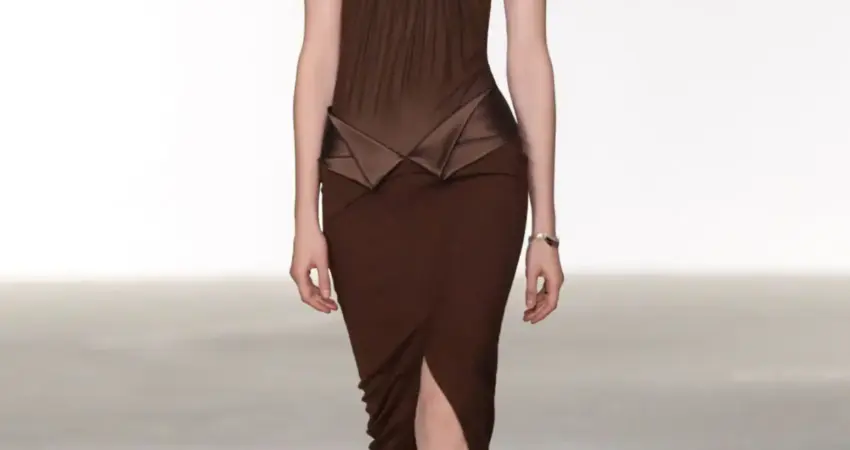
The latest collection from Oude Waag, led by designer Jingwei Yin, marks a significant evolution in the brand’s narrative, moving away from rigid structures toward a more fluid and emotionally resonant aesthetic. Drawing from a transformative period of personal adversity, Yin has developed a sartorial language that seeks to bridge the gap between emotional defense and psychological openness. This collection does not attempt to offer a simplified resolution to hardship; rather, it explores the nuanced process of moving forward while acknowledging the weight of the past. By juxtaposing sharp, protective tailoring with ethereal, liquid draping, Yin has crafted a series of garments that reflect the complexities of the human experience, grounded in technical mastery and a deep appreciation for the contradictions inherent in modern femininity.
The Evolution of Oude Waag and the Creative Vision of Jingwei Yin
Founded in Shanghai in 2017, Oude Waag has rapidly ascended as one of the most intellectually rigorous labels in the contemporary Chinese fashion landscape. The brand’s name, which refers to an "old weigh house," suggests a preoccupation with balance, value, and the physical weight of materials. Jingwei Yin, an alumnus of the prestigious Royal Academy of Fine Arts in Antwerp, brought a European sensibility to his Chinese heritage, creating a brand identity defined by intellectual depth and structural innovation.
Before establishing Oude Waag, Yin honed his skills under the tutelage of Haider Ackermann, a designer renowned for his mastery of silhouette and his ability to blend nomadic sensibilities with high-fashion tailoring. This influence remains evident in Yin’s work, particularly in his sophisticated approach to fabric manipulation. However, Yin has carved out a distinct niche by integrating Eastern philosophies of construction with Western draping techniques. His latest collection serves as a culmination of these various influences, utilizing fashion as a medium to process complex emotional states.
Technical Synthesis: Bridging Eastern and Western Design Philosophies
A primary highlight of the new collection is the seamless integration of Western draping and Eastern flat-cutting techniques. In Western fashion history, draping is often associated with the three-dimensional manipulation of fabric directly on a dress form, a method popularized by icons such as Madeleine Vionnet and Madame Grès. Conversely, traditional Eastern design—particularly in China and Japan—has historically relied on flat-cutting, where the garment’s shape is determined by the dimensions of the fabric roll, creating a more architectural and geometric relationship with the body.
Yin’s ability to merge these two disparate approaches allows for garments that possess both structural integrity and organic movement. "I see a connection between draping and the flat-cutting techniques of Eastern and Japanese design, and I try to bring these approaches together in a modern way," Yin explained during the collection’s presentation. He views draping not merely as a construction method but as a form of "sculpture" that requires a holistic synchronization of the eye, mind, and hands. This hands-on approach is visible in the way fabrics are knotted, twisted, and gathered, creating silhouettes that appear to be in a state of constant flux.
Materiality and the Narrative of Emotional Armor
The collection’s thematic progression is mirrored in its choice of materials and textures. The opening looks featured sharp tailoring and neat contours, representing what Yin describes as "emotional armor." These pieces utilized heavier fabrics and precise lines to create a sense of protection and boundaries. As the show progressed, these rigid structures began to give way to "liquid" draping, floating chiffon, and surfaces that appeared washed and timeworn.
This transition from the solid to the fluid serves as a metaphor for the thawing of an emotional state. The use of timeworn surfaces suggests a history of wear—not as a sign of decay, but as evidence of endurance. The contrast between the structured and the diaphanous lent the clothes an intriguing sensuality, one that felt earned rather than superficial. By allowing construction to provide the underlying substance, Yin ensured that the more delicate elements of the collection never felt fragile or decorative, but rather possessed a quiet strength.
The Role of Chance: Pomo Techniques and Ink-Splash Prints
One of the most visually striking elements of the collection was the introduction of ink-splash prints, inspired by the "pomo" technique of traditional Chinese ink painting. Pomo, or "splashed ink," is a style characterized by the bold, spontaneous application of ink onto paper or silk, allowing for an element of chance and abstraction. In the context of Yin’s collection, these prints served to break the "calibrated composition" of the garments.
The inclusion of these prints reflects a broader philosophical shift in Yin’s work. By embracing the unpredictable nature of the ink-splash, the designer acknowledges that life rarely follows a linear or controlled path. These patterns, appearing on earthy browns and muted grays, introduced a layer of visual complexity that mirrored the internal "mystery" Yin finds so compelling in women. The color palette itself told a story of gradual re-emergence; the somber tones of the early looks eventually gave way to a sudden, vibrant slash of crimson. This use of red was not presented as a "grand declaration of recovery," but rather as a "renewed appetite for life," suggesting that vitality often returns in sharp, unexpected bursts.
Market Analysis and the Rise of the Independent Chinese Designer
The success of Oude Waag is indicative of a broader trend within the global fashion industry: the rise of independent Chinese designers who are moving beyond the "Made in China" label to define a "Designed in China" aesthetic. According to recent market data from McKinsey & Company, the Chinese luxury market is expected to account for 25% of global luxury spending by 2025. Within this market, there is a growing appetite for "quiet luxury" and "intellectual fashion"—brands that offer high-quality craftsmanship and a unique narrative rather than overt logos.
Oude Waag’s positioning at the intersection of artisanal technique and emotional storytelling makes it particularly appealing to this demographic. The brand’s ability to compete on a technical level with established European houses, while maintaining a distinct cultural and personal viewpoint, has allowed it to secure placement in prestigious international retailers. Industry analysts suggest that Yin’s focus on "women’s complexities" and "mystery" resonates with a modern consumer who seeks clothing that reflects their internal identity rather than just their external status.
Comparative Context: The Legacy of Antwerp and the Influence of Ackermann
To fully understand the significance of Yin’s latest work, one must look at the lineage of the Royal Academy of Fine Arts in Antwerp. As a graduate of the institution that produced the "Antwerp Six," Yin is part of a tradition that prioritizes individual expression and technical rigor over commercial trends. His time with Haider Ackermann further refined this approach, instilling a sense of "poetic tailoring" that is evident in the way Oude Waag garments interact with the wearer’s movement.
While many contemporary designers rely on digital prints or high-tech fabrics to create visual interest, Yin’s reliance on manual techniques—knotting, gathering, and hand-draping—sets him apart. This commitment to the "hand-on approach" aligns him with a movement of designers who are returning to the craft of dressmaking as a form of resistance against the fast-paced, digital-first nature of modern fashion.
Broader Implications: Fashion as a Tool for Psychological Processing
The Oude Waag collection raises important questions about the role of fashion in the modern world. Can clothing serve as a medium for processing grief or personal transition? Yin’s work suggests that it can. By giving physical form to abstract concepts like "armor" and "openness," he provides a visual vocabulary for the human experience of resilience.
The collection was most convincing when it allowed for contradictions. In an industry that often demands clear themes and marketable "trends," Yin’s refusal to provide a tidy narrative arc is a bold choice. The clothes do not promise healing or a return to a pre-adversity state; instead, they acknowledge that the "mystery" of life lies in its unexpected turns. This honesty gives the collection a depth that transcends the seasonal nature of fashion.
Conclusion and Future Outlook
As Oude Waag continues to grow, Jingwei Yin remains focused on the intricate balance between construction and emotion. The latest collection demonstrates a designer who is coming into his full power, utilizing his technical expertise to explore profound human themes. By synthesizing Eastern and Western design philosophies and embracing the beauty of complexity, Yin has created a body of work that is both timely and timeless.
Looking forward, the brand is expected to expand its presence in key international markets, including Paris and New York, where the demand for sophisticated, narrative-driven design continues to rise. For Yin, however, the primary goal remains the exploration of the feminine form and the myriad ways it can be expressed through fabric. As he noted at the conclusion of his presentation, "I love women’s complexities. But above all, I’m drawn to their mystery." This commitment to the unknown ensures that Oude Waag will remain a vital and compelling voice in the global fashion conversation for years to come.

0 Comments