
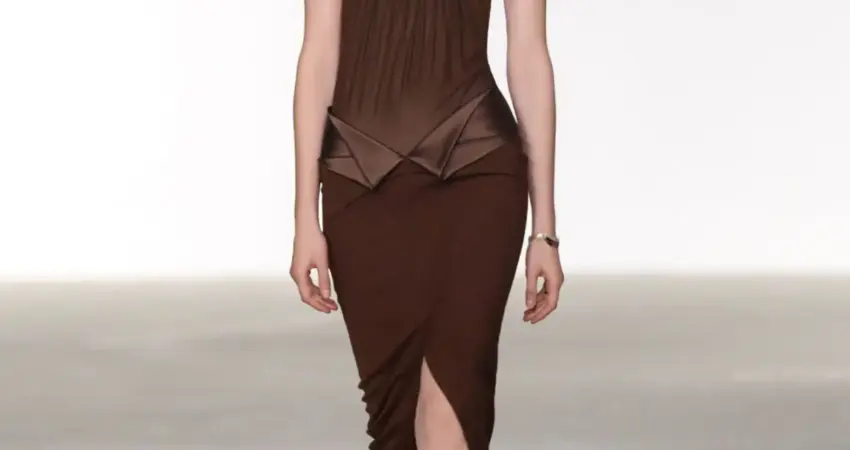
The latest collection from Oude Waag, the Shanghai-based label helmed by designer Jingwei Yin, marks a significant departure from traditional seasonal narratives by centering on the non-linear process of emotional recovery and the structural evolution of the feminine silhouette. Moving beyond the conventional tropes of "adversity overcome," Yin utilized his most recent runway presentation to examine the transition from emotional defensiveness—characterized by structured, armor-like garments—to a state of vulnerability and openness. This thematic progression was mirrored in the technical execution of the garments, which blended the rigorous precision of Western tailoring with the fluid, experimental nature of Eastern draping techniques. By refusing to provide a tidy resolution to the themes of loss and transition, the collection has garnered attention for its intellectual depth and its refusal to simplify the complexities of the human experience.
The Evolution of Oude Waag and the Vision of Jingwei Yin
Since its inception in 2017, Oude Waag has established itself as a critical player in the "New Chinese" design movement, a cohort of designers who prioritize intellectualism and craftsmanship over fleeting trends. Jingwei Yin, a graduate of the prestigious Royal Academy of Fine Arts in Antwerp, brings a pedigree of European technical excellence to his work. His formative professional years were spent under the tutelage of Haider Ackermann, a designer renowned for his mastery of color and draped silk. The influence of Ackermann is evident in Yin’s sophisticated understanding of how fabric interacts with the moving body, yet Yin has carved out a distinct niche by integrating these skills with a deep appreciation for Asian aesthetics and philosophical concepts.
The latest collection serves as a physical manifestation of Yin’s personal journey through a period of significant difficulty. Rather than presenting a collection that celebrates a "return to form," Yin focused on the "middle space"—the period of time where an individual is no longer in the depths of crisis but has not yet reached a state of total resolution. This nuanced approach allowed for a collection that felt grounded in reality, appealing to a consumer base that increasingly values authenticity and emotional resonance in luxury fashion.
Technical Synthesis: Bridging Eastern and Western Design Philosophies
A cornerstone of the Oude Waag aesthetic is the synthesis of seemingly disparate design philosophies. In this collection, Yin explored the tension between the "flat-cutting" techniques traditional to Japanese and Chinese garment construction and the three-dimensional "draping" techniques perfected in European ateliers.
"I see a connection between draping and the flat-cutting techniques of Eastern and Japanese design, and I try to bring these approaches together in a modern way," Yin explained during a post-show briefing. According to the designer, draping is not merely a method of assembly but a form of "sculpture" or "drawing" that requires a holistic alignment of the eye, mind, and hands. This was evidenced in garments where sharp, architectural tailoring met liquid-like chiffon. The presence of neat contours provided a sense of security and "armor," while floating overlays and washed, timeworn surfaces suggested a softening of the wearer’s exterior.
The use of "washed" surfaces is particularly notable. In the context of luxury fashion, where "newness" is often equated with perfection, Yin’s decision to use fabrics that appeared lived-in or weathered served to reinforce the theme of enduring through time. These textures provided a tactile representation of resilience, suggesting that beauty can be found in the marks left by experience.
The Role of Pomo: Chinese Ink Painting as a Design Element
To further emphasize the theme of "chance" and the unpredictability of life, the collection integrated prints inspired by the "Pomo" (broken ink) technique of traditional Chinese ink painting. Pomo is characterized by the application of ink in a way that allows for natural diffusion and bleeding, resulting in shapes that are not entirely under the artist’s control.
By translating this technique onto fabric, Yin introduced an element of spontaneity into an otherwise highly calibrated and technical collection. The ink-splash prints functioned as a visual metaphor for the unexpected turns of life—those moments that cannot be planned for but must be integrated into one’s identity. This application of traditional art forms in a contemporary fashion context highlights Oude Waag’s role in the ongoing dialogue regarding the modernization of Chinese cultural heritage.
Chronology of the Runway: From Armor to Acceptance
The runway show was structured to reflect a gradual shift in mindset, a progression that was communicated through a meticulously curated color palette and evolving silhouettes.
- The Phase of Protection: The opening looks featured earthy browns and muted grays, colors that suggest a grounding in the material world. The silhouettes were defined by heavy tailoring and knots that seemed to bind the fabric closely to the body. This "armor" phase represented the initial response to adversity—a closing off and a focus on structural integrity.
- The Phase of Integration: As the show progressed, the garments became more fluid. The introduction of twisted and gathered fabrics suggested a loosening of the previously rigid structures. Here, the Pomo prints began to appear, signaling the introduction of "chance" into the narrative.
- The Phase of Re-emergence: The climax of the collection was marked by a sudden, deliberate "slash of crimson." In a sea of neutrals, this vibrant red served as a potent symbol of a renewed appetite for life. Critically, Yin avoided using this color as a "grand declaration of recovery." Instead, it functioned as a pulse—a sign of vitality that exists alongside the muted tones of the past.
Market Context and the Rise of Independent Chinese Designers
The success of Oude Waag comes at a time when the global fashion industry is increasingly looking toward China not just as a consumer market, but as a source of high-level creative talent. Data from the China Fashion Association indicates that the market for independent designer brands in China has grown at a compound annual growth rate (CAGR) of approximately 20% over the last five years. Consumers, particularly those in the "Gen Z" and "Millennial" demographics, are shifting their spending toward brands that offer unique narratives and cultural depth.
Industry analysts suggest that Oude Waag’s ability to blend high-concept emotional storytelling with wearable, sophisticated tailoring positions the brand well for international expansion. While many independent labels struggle to balance artistic expression with commercial viability, Yin’s background in European luxury houses provides him with a technical foundation that ensures his most avant-garde pieces remain functional and appealing to the luxury buyer.
Reactions and Industry Implications
While official statements from retail partners remain focused on the collection’s commercial potential, critics have praised the show for its maturity. Fashion commentators have noted that Yin’s work avoids the "theatricality for theatricality’s sake" that often plagues young designers. Instead, the collection is seen as a "thoughtful meditation" on the role of clothing as a psychological tool.
The broader implications of this collection suggest a shift in the "New Chinese" aesthetic away from overt cultural symbols and toward a more internalized, philosophical interpretation of heritage. By focusing on the "mystery" and "complexity" of the modern woman, as Yin stated, Oude Waag is contributing to a more nuanced representation of femininity in fashion—one that acknowledges struggle and contradiction as essential components of strength.
Conclusion: A Non-Linear Path Forward
In an industry often obsessed with the "new" and the "next," Oude Waag’s Spring Summer collection serves as a reminder of the power of looking back and processing the present. The collection’s strength lies in its refusal to offer easy answers. It acknowledges that healing is not a destination but a process, and that the clothes we wear can act as both a shield and a bridge during that journey.
As Jingwei Yin continues to develop his design language, his commitment to technical excellence and emotional honesty suggests that Oude Waag will remain at the forefront of the contemporary fashion dialogue. By giving form to the idea that life rarely proceeds in a straight line, Yin has created a collection that is not only aesthetically compelling but deeply human, marking a milestone in his career and the evolution of modern Chinese design. The "mystery" he seeks to capture in his work remains his greatest asset, ensuring that each subsequent collection is not just a display of clothing, but a continuation of an ongoing, sophisticated narrative.

0 Comments