
The landscape of New York Fashion Week has long been defined by its movement across the city’s boroughs, transitioning from the tents of Bryant Park to the industrial galleries of Chelsea and the shores of Brooklyn. However, for the Spring 2027 season, Raul Lopez, the creative force behind the label Luar, established a new geographic and cultural benchmark by staging his runway show in the heart of Queens. The chosen venue, Flushing Meadows-Corona Park, provided a monumental backdrop: the Unisphere, a 120-foot-wide stainless steel globe originally commissioned for the 1964-1965 World’s Fair. This choice of location was not merely a logistical decision but a symbolic homecoming and a statement on the decentralization of the global fashion capital.
Lopez, a designer whose work often interrogates the intersections of identity, heritage, and urban survival, titled the collection "Christopher Street Columbus." The name serves as a complex linguistic and historical portmanteau, bridging the history of European colonization in the Americas with the modern legacy of Christopher Street in Manhattan’s West Village—a historic epicenter for the LGBTQ+ community. By bringing this narrative to the shadow of the Unisphere, Lopez sought to reclaim historical narratives through a contemporary queer and Dominican lens.
Historical Context and the Significance of the Unisphere
The Unisphere was designed by Gilmore D. Clarke for the 1964 World’s Fair to celebrate the theme of "Peace Through Understanding" and the dawn of the Space Age. For Lopez, however, the structure represented a personal and communal landmark. During the design process, Lopez noted that there was "no plan B" for the location. His connection to Queens is rooted in personal history; the designer frequently visits the borough’s diverse neighborhoods and frequents its nightlife establishments.
The choice of Flushing Meadows-Corona Park also mirrors the shifting demographics of New York City’s creative class. As Manhattan becomes increasingly prohibitively expensive, the cultural energy has migrated outward. By hosting a major fashion event in Queens, Luar signaled a commitment to the communities that have long influenced the "downtown" aesthetic without always receiving formal recognition from the fashion establishment.
The Narrative of "Christopher Street Columbus"
The conceptual framework of the Spring 2027 collection rested on the idea of "reclamation." As a designer of Dominican descent, Lopez utilized the collection to address the legacy of Christopher Columbus, whose first voyage to the Americas led to his arrival in what is now the Dominican Republic and Haiti. By pairing "Columbus" with "Christopher Street," Lopez juxtaposed the violence of colonial history with the sanctuary of queer spaces.
The designer explained that the collection was an exploration of "dressing up for survival." This concept refers to the way marginalized communities, particularly queer people of color, have historically used fashion as both a suit of armor to navigate hostile environments and a tool for rebellion. The garments were intended to reflect a dual need: the necessity to "fit in" for safety and the desire to stand out as an act of defiance.
Technical Analysis of the Spring 2027 Collection
The collection displayed a sophisticated blend of 16th-century Tudor influences and modern streetwear. This historical bridge allowed Lopez to play with proportions that suggested both royal court attire and contemporary urban silhouettes.
Silhouettes and Tailoring
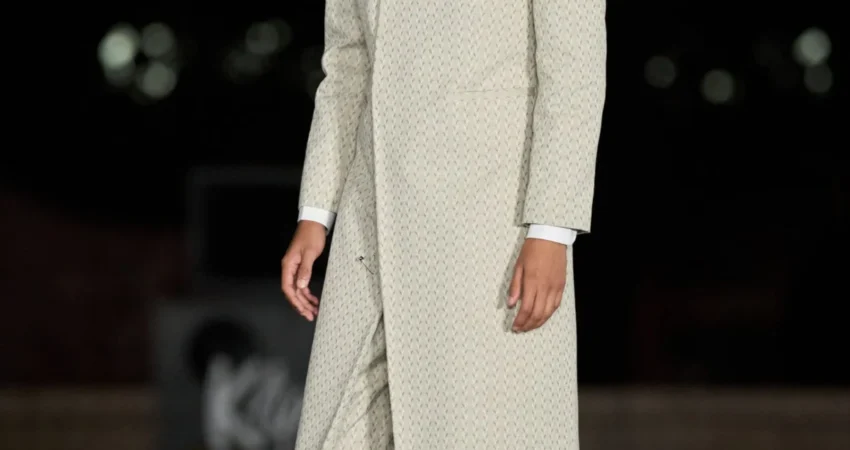
The runway featured full pleated breeches, a direct nod to the Tudor era, which were unexpectedly paired with double-breasted suit jackets and rugged biker jackets. The biker jackets were updated with sloping, exaggerated shoulders, a hallmark of the Luar aesthetic. Sharp-shouldered coats featured unique neck closures that evoked the high collars of the Renaissance, while leather bodices were constructed with dramatic puffed sleeves, blending the masculine and the feminine into a singular, fluid identity.
Textile Innovation and Cacao Pod Prints
One of the most technically significant aspects of the collection was the use of custom textiles derived from Lopez’s travels to the Dominican Republic. The designer photographed cacao pods in various stages of growth and decay, capturing a spectrum of yellows, greens, and browns. These images were digitally scanned and printed onto silk, resulting in high-contrast patterns used for tailored suits and draped tops.
Furthermore, the collection utilized umber jacquards to mimic the earthy, decaying textures of fermented cacao, providing a tactile connection to the Dominican landscape. Other notable fabrications included:
- Striped Velvet: Brown-and-black striped velvet was used for broad-shouldered suits with nipped-in waists.
- Dyed Lace: Smoky skirts were crafted from intricately dyed lace, offering a delicate contrast to the heavy tailoring.
- Moiré: Several of the more understated looks were rendered in creamy navy moiré, a silk fabric with a rippled or "watered" appearance that has historically been associated with high-status garments.
Evening Wear and Finishes
The show concluded with a series of sequined dresses featuring asymmetric hems. These pieces were finished with feather sashes at the waist, adding a sense of movement and "bounce" to the final looks. The use of feathers, specifically with curled tips for added volume, underscored Lopez’s reputation as a showman who prioritizes visual impact.
Accessories and Strategic Collaborations
Luar has achieved significant commercial success through its accessory line, most notably the "Ana" bag, which has become a recognizable "it-bag" in the contemporary luxury market. For the Spring 2027 season, Lopez expanded his accessory offerings through strategic partnerships and historical research.
MCM and Kenner Collaborations
The collection introduced a series of pouchettes created in collaboration with the luxury brand MCM, integrating MCM’s signature logo-print heritage with Luar’s structural design language. In a move toward global lifestyle branding, Lopez also partnered with the Brazilian brand Kenner to produce sporty, elevated flip-flops, suggesting a democratization of the Luar aesthetic.
Historical Jewelry and "Ripped" Styling
A notable detail that caught the attention of fashion historians and social media enthusiasts alike was the use of "ripped" gloves that revealed bejeweled fingers. Lopez discovered this practice—originally popular in the 1500s—via research on TikTok, illustrating how digital trends and historical archives now inform modern design. The jewelry was styled to appear as if it were bursting through the fabric, symbolizing the "reclamation" theme by showing wealth and beauty breaking through constraints.
Event Chronology and Logistics
The event at Flushing Meadows-Corona Park was a logistically complex undertaking. Guests were transported from Manhattan and various parts of Brooklyn to the park, where the 120-foot Unisphere served as the primary set piece.
- Pre-Show (6:30 PM – 7:30 PM): Attendees arrived as the sun began to set, using the Unisphere as a backdrop for photography. The crowd was a mix of fashion industry veterans, celebrities, and local Queens residents who gathered to watch the spectacle from the park’s perimeter.
- The Runway (8:00 PM): The show commenced under artificial lighting that illuminated the stainless steel continents of the Unisphere. Models navigated a wide perimeter around the globe, emphasizing the scale of the environment.
- Post-Show Analysis: Immediately following the show, critics noted the cinematic quality of the production. While the venue was praised for its ambition, some observers noted that the sheer scale of the 12-story globe occasionally dwarfed the intricate details of the clothing, such as the lace textures and the scanned cacao prints.
Market Implications and Industry Impact
Raul Lopez’s decision to show in Queens is part of a broader trend of "destination shows" within New York Fashion Week. As brands seek to create "viral moments," the choice of venue has become as important as the clothing itself. However, unlike brands that choose exotic international locations, Luar’s choice of Queens was an exercise in "hyper-localism."
From a business perspective, the collection demonstrates Luar’s readiness to compete on a global scale. By collaborating with established brands like MCM and expanding into diverse footwear categories with Kenner, Lopez is diversifying his revenue streams beyond the Ana bag. The inclusion of high-concept evening wear and complex textile development also suggests a move toward a higher price point and a more "couture" approach to ready-to-wear.
Analysis of the "Queens Frontier"
The Spring 2027 show marks a pivotal moment for Luar. By successfully executing a large-scale production at the Unisphere, Lopez has proven that the "outer boroughs" are not just peripheral locations but are central to the narrative of New York fashion. The collection "Christopher Street Columbus" serves as a reminder that fashion is a powerful medium for historical dialogue. Through his use of Tudor silhouettes and Dominican-inspired textiles, Lopez has created a visual language that speaks to the complexities of identity in a post-colonial world.
While the vastness of the Unisphere presented a challenge in terms of garment visibility, the symbolic weight of the location provided a depth that a traditional white-box gallery could not offer. The event underscored the designer’s belief that fashion should be an immersive experience that reflects the community from which it arises. As the industry continues to evolve, the Luar Spring 2027 show will likely be remembered as the moment the "world’s fair" of fashion finally arrived in Queens.

0 Comments