
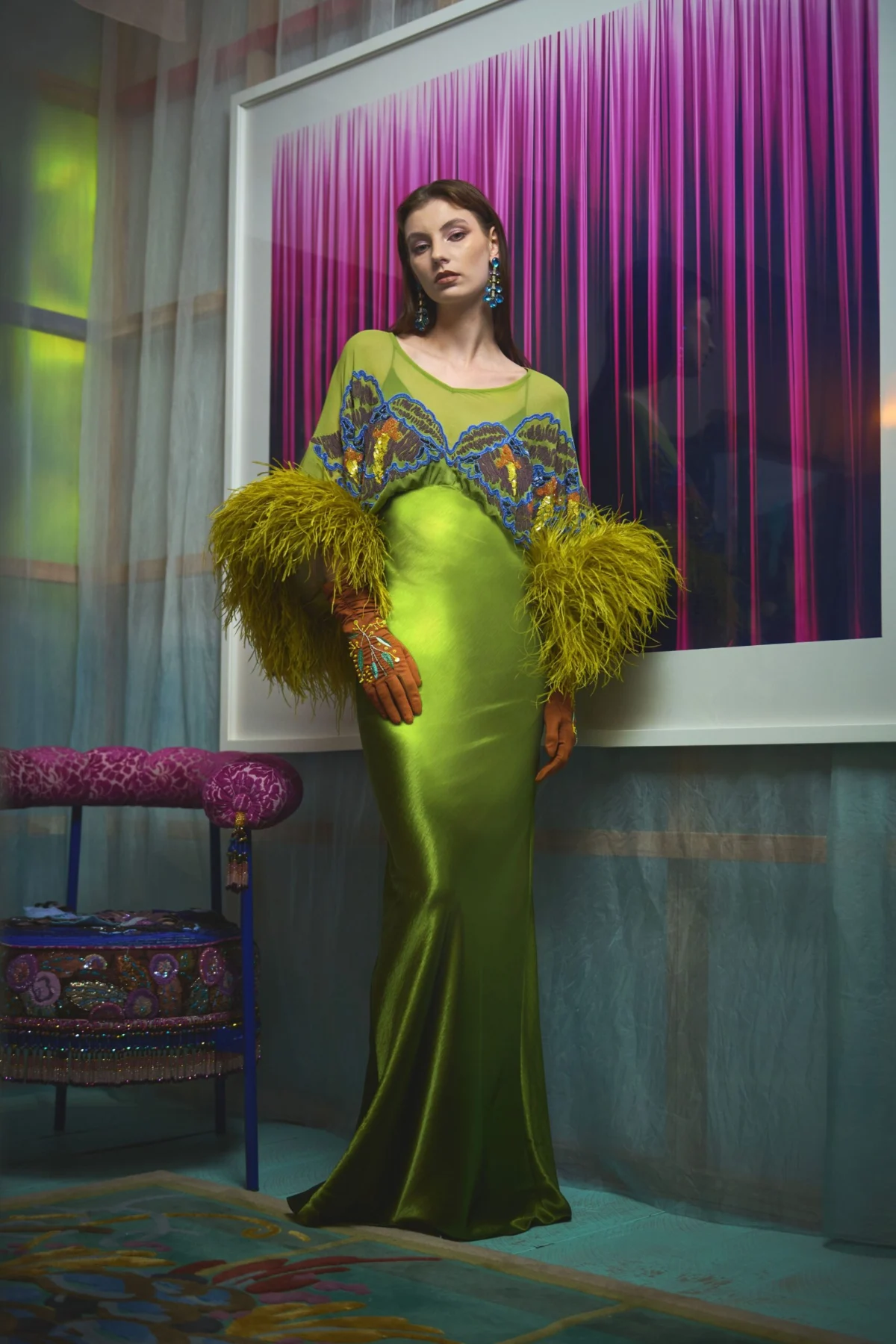
The Australian fashion landscape witnessed a significant shift in traditional presentation formats this season as Romance Was Born, the Sydney-based label celebrated for its avant-garde and whimsical aesthetic, opted to bypass the conventional runway schedule of Australian Fashion Week. Instead, designers Luke Sales and Anna Plunkett directed their creative focus toward Melbourne Design Week, marking a strategic move into the realm of interior design and circular sustainability. Partnering with Cultivated—the specialized in-house furniture refurbishing and sustainability arm of Cult Furniture—the duo unveiled an exhibition that merged high-fashion textile artistry with furniture restoration. This pivot comes exactly one year after the brand celebrated its 20th anniversary, signaling a new chapter for a label that has long occupied the intersection of wearable art and cultural commentary.
The collaboration, staged in Melbourne, featured a series of recycled furniture pieces revitalized through Romance Was Born’s signature lens of maximalism and intricate embellishment. By utilizing archival fabrics and upcycled materials, Sales and Plunkett sought to demonstrate the versatility of their design language beyond the human form. This transition into the design space was not a departure from their sartorial roots but rather an extension of them. While the designers confirmed that seasonal collections remain a core component of the brand’s output, the decision to prioritize a design-focused exhibition reflects a growing trend among luxury labels to engage with the principles of the circular economy and multidisciplinary artistry.
A Strategic Pivot: From the Runway to the Gallery
The decision to step back from the traditional runway circuit was a calculated one. Following a high-profile 20th-anniversary show in 2023, Sales and Plunkett sought a medium that allowed for a more permanent and tactile engagement with their audience. Speaking on the transition, Sales noted that the project with Cultivated represented a long-held ambition to apply the brand’s aesthetic to the domestic sphere. The move aligns with a broader industry shift where designers are increasingly seeking ways to extend the lifecycle of their work and reduce the environmental footprint associated with high-frequency runway productions.
Melbourne Design Week provided the ideal backdrop for this exploration. As Australia’s premier international design event, it offers a platform for innovation across architecture, industrial design, and craft. By embedding themselves within this context, Romance Was Born effectively bridged the gap between the ephemeral nature of fashion and the enduring nature of furniture. The resulting exhibition was not merely a display of objects but a narrative-driven environment where the distinction between a garment and a piece of furniture was intentionally blurred.
Historical Foundations and the Powerhouse Museum Residency
The creative impetus for the latest collection and the accompanying furniture pieces was deeply rooted in the brand’s current environment. Romance Was Born maintains a studio residency within the Powerhouse Museum in Sydney, a prestigious cultural institution that houses an extensive collection of historical artifacts, science, and design. This residency granted the designers unprecedented access to a vast archive of historical textiles, which became the foundational elements of their current work.
Primary among these influences was the work of Auguste Thomas, a French designer known for his intricate, handmade Art Deco wallpapers. The geometric precision and ornate motifs of Thomas’s designs served as the blueprint for the collection’s visual language. Additionally, the designers integrated traditional French lace and vintage Italian bedspreads into their work, creating a sense of "modern antiquity." This approach involves taking historical materials—often relegated to the past—and recontextualizing them through contemporary silhouettes and construction techniques.
The collection featured slender, bias-cut dresses that utilized the weight and texture of vintage bedspreads to create fluid, sculptural forms. Some pieces incorporated capes and sleeveless designs, while others were adorned with ostrich feather trims and paired with evening gloves, evoking the glamour of early 20th-century cinema. These were contrasted with more contemporary elements, such as embellished denim pencil skirts and flannel pairings, demonstrating the brand’s ability to navigate between historical reverence and modern subversion.
A Chronology of Two Decades of Innovation
To understand the significance of this latest venture, it is essential to trace the trajectory of Romance Was Born since its inception:
- 2005: Luke Sales and Anna Plunkett found Romance Was Born after meeting at fashion school. The brand quickly gains a reputation for its refusal to adhere to minimalist trends.
- 2009-2015: The label becomes a staple of Australian Fashion Week, known for immersive shows that often incorporate live performances, elaborate sets, and collaborations with artists like Del Kathryn Barton.
- 2016: The brand’s work is increasingly recognized by major institutions, leading to acquisitions by the National Gallery of Victoria and the Powerhouse Museum.
- 2020-2022: During the global pandemic, the brand focuses on localized production and small-batch "Co-Op" collections, utilizing deadstock fabrics and vintage finds.
- 2023: Romance Was Born celebrates its 20th anniversary with a landmark show that revisits two decades of archival themes, cementing its status as a pillar of Australian design.
- 2024: The brand pivots to Melbourne Design Week, launching its collaboration with Cultivated and emphasizing a multidisciplinary, sustainable approach to luxury.
The Cultivated Partnership and the Circular Economy
The partnership with Cultivated represents a significant foray into the circular economy. Cultivated is a program designed to manage the lifecycle of authentic designer furniture, offering refurbishment, repair, and buy-back services to prevent high-quality pieces from entering landfills. By applying Romance Was Born’s textile expertise to these refurbished pieces, the collaboration highlights the potential for "upcycling" to reach the highest tiers of the luxury market.
One of the standout pieces in the exhibition was an upcycled couch paired with an embroidered patchwork jacket featuring a fuchsia feather collar. The visual synergy between the furniture and the apparel was intentional; the jacket was designed to "talk" to the furniture, creating a cohesive aesthetic world. This approach challenges the traditional "siloed" nature of design industries, suggesting that the future of luxury lies in a holistic lifestyle approach where the home and the wardrobe are intrinsically linked.
Industry data supports this shift toward sustainability. According to recent reports on the Australian circular economy, the textile and furniture sectors are among the largest contributors to commercial waste. By championing refurbishment and the use of archival materials, Romance Was Born and Cultivated are providing a blueprint for how brands can maintain a high-end image while adhering to environmental responsibilities.
Fact-Based Analysis: Implications for the Australian Fashion Industry
The move by Romance Was Born to skip a traditional runway show in favor of a design exhibition carries several implications for the broader industry:
- Diversification of Revenue Streams: By expanding into furniture and interior design, fashion brands can tap into a different market segment, offering "lifestyle" products that may have a longer retail life than seasonal clothing.
- Sustainability as a Design Driver: The use of archival textiles and refurbished furniture is no longer a niche practice but a core design philosophy. This sets a precedent for other Australian labels to explore creative ways to handle deadstock and waste.
- The Rise of "Slow Fashion" Events: The success of the Melbourne Design Week exhibition suggests that consumers and critics are increasingly receptive to slower, more contemplative presentation formats that prioritize craftsmanship over the spectacle of a 15-minute runway show.
- Institutional Integration: The brand’s residency at the Powerhouse Museum highlights the importance of institutional support for creative industries. Access to archives allows for a level of depth and historical continuity that is often missing in fast-paced commercial fashion.
Official Responses and Creative Philosophy
While the designers have often been characterized by their "over-the-top" nature, Sales and Plunkett maintain that their work is underpinned by a specific brand of "weird humor." This humor is evident in the juxtaposition of high-brow historical references with kitsch elements, such as pairing a "mod" mini dress with contrasting coral tights.
Sales explained that the goal of the collection, shot within the halls of the Powerhouse Museum, was to create a visual narrative reminiscent of a "silent film restored by modern technology." This metaphor aptly describes the brand’s process: taking the "silent" or forgotten elements of history—the old lace, the discarded wallpaper, the vintage bedspread—and using modern design technology and artistic vision to bring them back to vibrant life.
The reaction from the design community has been largely positive, with critics noting that Romance Was Born has successfully translated its "more-is-more" philosophy into a medium that demands structural integrity and longevity. The collaboration with Cultivated has been praised for its ability to make sustainable practices look aspirational rather than utilitarian.
Future Outlook: The Evolution of the "Romantic" Aesthetic
As Romance Was Born enters its third decade, the brand appears to be moving toward a model that favors artistic depth and environmental consciousness over high-volume production. The success of the Melbourne Design Week exhibition suggests that the brand’s audience—the "dedicated Romantics"—are willing to follow Sales and Plunkett into new territories, whether that be a gallery, a museum, or a furniture showroom.
The Spring 2026 Ready-to-Wear collection, while informed by this design-centric project, will continue to provide the wearable art that the brand’s clientele expects. However, the influence of the Powerhouse archives and the experience of working with structural furniture design are likely to permeate future sartorial offerings. The brand is effectively building a "world" that encompasses not just what a person wears, but how they live, all while maintaining a commitment to the preservation of textile history and the promotion of a more sustainable, circular future for Australian design.

0 Comments