
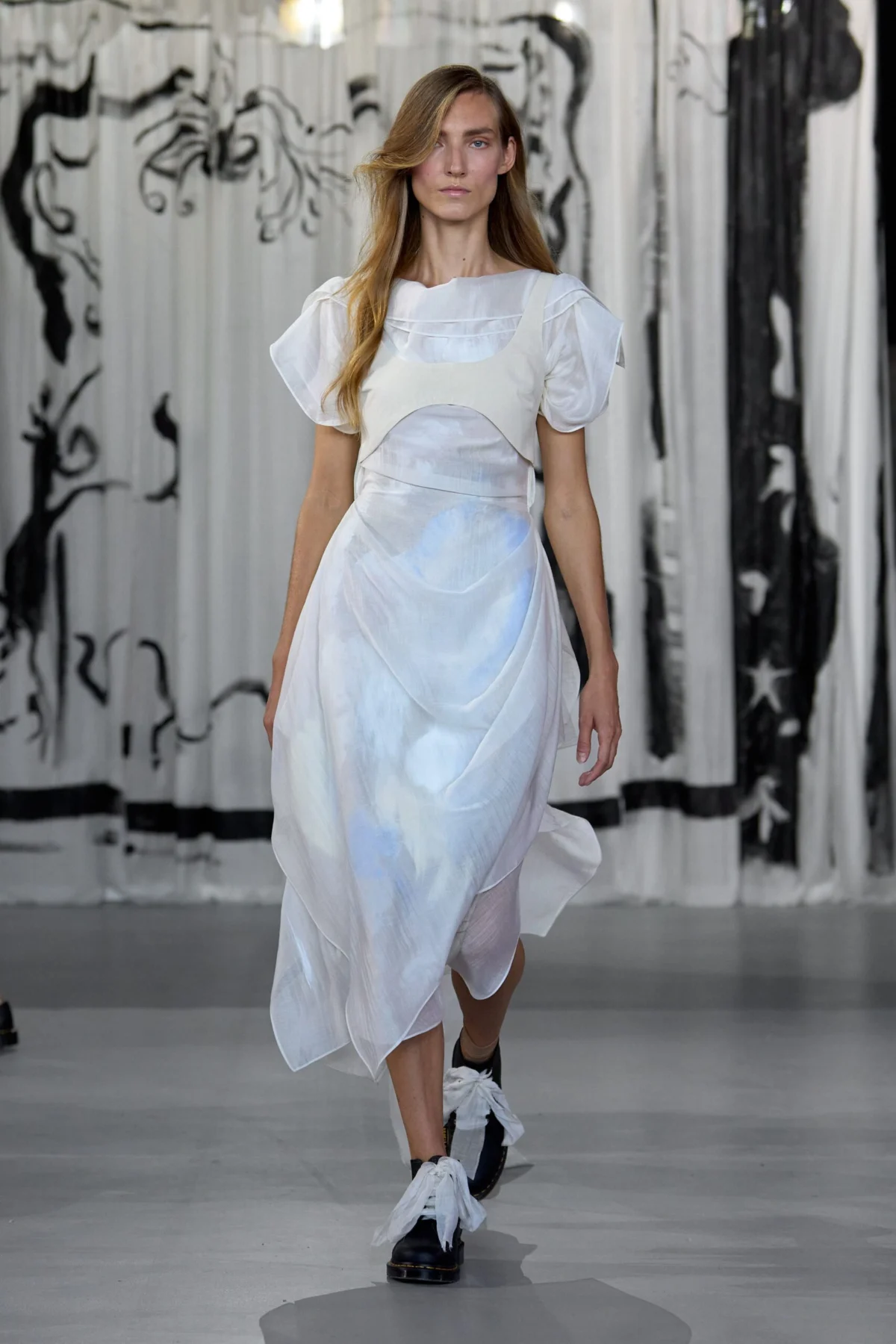
The Danish fashion house Stine Goya has officially marked its return to the runway for the Spring 2027 season, ending a two-year hiatus from the physical show circuit with a presentation that sought to bridge the gap between historical upheaval and contemporary transformation. Drawing profound inspiration from Florian Illies’ acclaimed historical narrative, 1913: The Year Before the Storm, creative director Stine Goya presented a collection that mirrored the frantic, high-stakes creativity of the early 20th century. The show, held during Copenhagen Fashion Week, was not merely a display of new garments but a conceptual exploration of "living as if there were no tomorrow," a sentiment Goya identified as a direct parallel to the current global climate of rapid technological shifts and social change.
The Conceptual Foundation: 1913 and the Dawn of Modernity
The Spring 2027 collection found its heartbeat in the year 1913—a pivotal moment in human history characterized by an explosion of artistic, scientific, and intellectual breakthroughs just before the onset of World War I. Goya’s interest in this period stems from the way European thinkers and artists collaborated and pushed boundaries during a time of immense uncertainty.
"There was really this sense of creativity and how they were working together that was really inspiring to me," Goya explained during a post-show briefing. "There was something that felt so parallel to the time that we live in today."
This historical anchor allowed the brand to explore themes of disruption. While the contemporary world grapples with the gradual but pervasive influence of artificial intelligence, the world of 1913 faced the "shock of the new" through radical shifts in visual arts and performance. Goya specifically referenced the International Exhibition of Modern Art, known as the Armory Show, which introduced the American public to Cubism and the avant-garde. The collection sought to capture that same sense of friction—the moment when tradition meets a future it does not yet fully understand.
Runway Choreography and Inclusive Design
A central tenet of the Spring 2027 presentation was the democratization of the fashion show experience. After a two-year absence, the brand sought to re-engage its audience through a unique seating arrangement designed to eliminate the traditional hierarchy of the "front row."
Thomas Herz, CEO of Stine Goya and the designer’s partner, noted that the runway was configured in concentric circles. This layout ensured that every guest in attendance had a front-row view of the garments. The models moved in circular patterns, a choreographic choice intended to mimic the movement of a clock. This symbolism served a dual purpose: it acknowledged the brand’s history while emphasizing a forward-moving trajectory.
The cyclical nature of the choreography also addressed industry critiques that the brand had been "treading water" in recent seasons. By physically breaking the models out of a linear path and into a spiraling movement, Goya visually signaled a departure from repetitive cycles and an evolution into a more sophisticated aesthetic territory.
Artistic Integration: From Stravinsky to Inline Skating
The show’s atmosphere was heavily influenced by the scandals of the early 20th-century art world. Goya integrated elements of the Ballets Russes, specifically referencing Vaslav Nijinsky’s erotic and controversial performance of Afternoon of a Faun. To open the show, the hauntingly modern music created by Igor Stravinsky for the ballet filled the venue, setting a tone of high drama and intellectual rigor.
In a nod to the juxtaposition of the old and the new, the traditional ballet influence was met with a contemporary performance element: an inline skater. This addition served to punctuate the "clockwork" movement of the models, adding a layer of kinetic energy and urban edge to the proceedings. The inclusion of the skater served as a metaphor for the speed of modern life and the fluid, often unpredictable nature of creative progress.
Aesthetic Evolution: A Shift Toward Cooler Glamour
For years, Stine Goya has been synonymous with a specific type of "cutesy" Danish aesthetic—bright colors, playful prints, and a soft, feminine approach to volume. The Spring 2027 collection, however, signaled a decisive shift toward a "cooler edge."
The evolution was evident in the styling and the material choices:
- Footwear: The signature soft aesthetic was grounded by ribbon-laced Dr. Martens, providing a utilitarian contrast to the delicate fabrics.
- Prints and Palettes: While florals remained a staple, they were reimagined through a lens of high-fashion maximalism. The collection featured rococo cartouches and a color palette reminiscent of 1990s-era Gianni Versace—bold, saturated, and unashamedly opulent.
- Embellishment: The use of dense, all-over beading on pieces like cardigan jackets demonstrated a move toward more labor-intensive, luxury-oriented craftsmanship.
- The "Strass" Influence: One of the most talked-about elements of the collection was the introduction of strass bras with loose back-laces. Designed to be worn as standalone pieces or layered over other garments, these items suggested a new direction for the brand: one where glamour and "sparkle" coexist with the softer prettiness of Goya’s earlier work.
Historical Timeline: The 1913 Inspiration Points
To understand the depth of the Spring 2027 collection, it is necessary to look at the specific historical events Goya utilized as her creative scaffolding:
- February 1913 – The Armory Show: The introduction of Marcel Duchamp’s Nude Descending a Staircase, No. 2 to New York. The painting was famously described by one critic as "an explosion in a shingle factory," representing the visceral reaction to modernism that Goya aimed to evoke in her return to the runway.
- May 1913 – The Rite of Spring: The premiere of Igor Stravinsky’s ballet in Paris, which led to a near-riot in the theater. This event serves as the ultimate symbol of "the shock of the new," a theme Goya integrated into her show’s soundtrack and pacing.
- 1913 – The Publication of Swann’s Way: Marcel Proust’s exploration of memory and time, which aligns with the "clock-like" movement of the Goya runway.
- Early 20th Century – The Ballets Russes: The eroticism and radical costume design of Leon Bakst and Vaslav Nijinsky, which informed the collection’s more provocative pieces, such as the strass bras and back-lace details.
Industry Context and Economic Implications
The return of Stine Goya to the runway comes at a critical time for the Danish fashion industry. Copenhagen Fashion Week (CPHFW) has solidified its position as the "fifth" global fashion capital, following New York, London, Milan, and Paris. This growth is driven by a focus on sustainability and a distinct "Scandi-cool" aesthetic that has high commercial viability.
According to data from the Danish Fashion & Textile (DM&T) association, the industry has seen a steady recovery in export volumes following the global supply chain disruptions of the mid-2020s. For a brand like Stine Goya, which has a significant international footprint, the transition from a "niche" playful brand to a more "glamorous and edgy" powerhouse is a strategic move to capture a larger share of the luxury contemporary market.
The two-year absence from the runway allowed the brand to restructure its internal operations and focus on digital engagement. However, the Spring 2027 show proves that the physical runway remains an essential tool for brand storytelling and emotional connection with buyers and critics.
Broader Impact: Fashion in the Age of AI
The designer’s mention of AI disruption highlights a growing sentiment within the creative industries. As generative tools become more integrated into the design process, many creators are looking backward to periods of human-centric radicalism to find authenticity.
By grounding her collection in the tangible, scandalous, and deeply human art of 1913, Goya is making a statement about the value of the "human touch" in fashion. The intricate beading, the specific historical references, and the live performance elements all serve to differentiate the brand from the homogenized outputs of algorithmic design.
The collection suggests that the future of fashion lies not in a total rejection of technology, but in a synthesis of historical depth and modern innovation. The "forward-moving direction" noted by critics at the show indicates that Stine Goya has successfully navigated her "breakout moment," moving beyond the repetitive cycles of her past to embrace a more complex and compelling vision of womanhood.
Conclusion and Future Outlook
The Stine Goya Spring 2027 collection serves as a manifesto for the brand’s second act. By leaning into the chaos and creativity of the pre-war avant-garde, the designer has found a way to make her brand feel relevant in a modern era defined by its own set of "shocks."
The move away from pure "cutesiness" toward a sophisticated, Versace-inflected glamour suggests that the Stine Goya woman is maturing. She is no longer just looking for a colorful dress for a garden party; she is looking for pieces that reflect the complexity of the world she inhabits—pieces that are as bold as a Duchamp painting and as rhythmic as a Stravinsky score. As the brand moves forward from this circular, clock-like presentation, the industry will be watching to see if this "cooler edge" becomes the new standard for Danish luxury.

0 Comments