
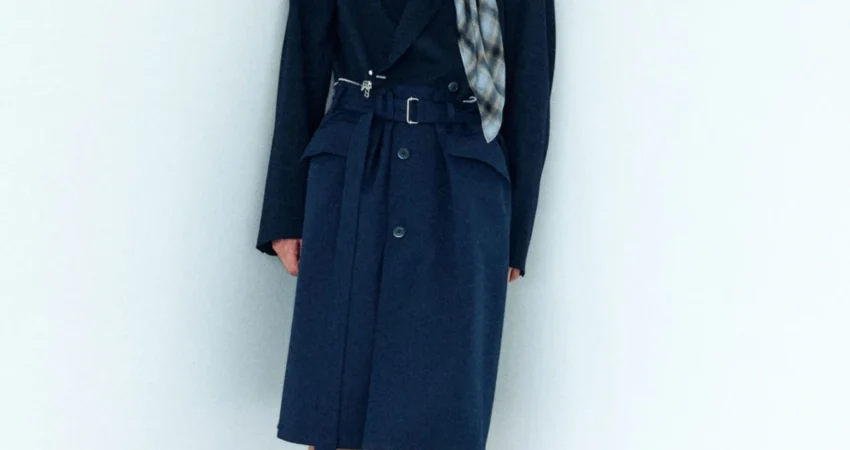
The Japanese fashion landscape has long been defined by its ability to synthesize disparate elements into cohesive, avant-garde expressions. Central to this contemporary movement is the concept of "docking"—a term widely utilized within the Japanese industry to describe the structural fusion of two or more distinct garments into a single, unified piece. While the term remains relatively obscure in Western fashion nomenclature, it serves as the foundational philosophy for Tatsuya Tamada and his label, Tamme. In his latest collection, Tamada continues to refine this methodology, moving beyond mere aesthetic hybridity to explore deeper themes of paternal influence, institutional authority, and the deconstruction of the traditional uniform.
The Technical Foundation of Docking and the Sacai Pedigree
To understand the trajectory of Tamme, one must first examine the professional lineage of its founder. Tatsuya Tamada is an alumnus of Sacai, the influential Japanese brand helmed by Chitose Abe. Abe is frequently cited by industry analysts as the "queen of hybridity," having spent decades perfecting the art of splicing contrasting textiles and silhouettes—such as MA-1 bomber jackets with pleated skirts or trench coats with knitwear.
Tamada’s tenure at Sacai provided him with a rigorous technical education in the "docking" process. However, since launching Tamme in 2021, he has sought to carve out a distinct identity by applying these techniques to more structured, masculine archetypes. While Sacai often emphasizes volume and feminine fluidity, Tamme focuses on the "three-panel construction" of tailoring and the rigid geometry of functional wear. This season represents a pivotal shift for the brand, as Tamada seeks to "soften" the technical edges of his previous work, moving from literal interpretations of uniforms toward a more nuanced, "sartorial palimpsest."
Paternal Inspiration: The Police Uniform as a Design Blueprint
The core narrative of the current Tamme season is rooted in Tamada’s personal history, specifically the image of his father, a career police officer. For many designers, the uniform represents a symbol of restriction; for Tamada, it serves as a site of exploration. Last season, the designer introduced elements of authority—sharp collars, epaulets, and structured pockets—into streetwise silhouettes. This year, the approach has evolved into a more abstract deconstruction of those same hallmarks.
The collection seeks to blur the lines between "the smart and the scuzzy," or more formally, between the buttoned-up rigidity of the state and the blasé attitude of modern urban subcultures. Tamada noted during his presentation that he aimed to take familiar elements, such as the standard pairing of a suit jacket and trousers with a dress shirt, and "soften the finish." This was achieved through meticulous adjustments to garment architecture: rounding out shoulder lines to remove the aggressive posture of a duty uniform and recalibrating lengths to disrupt the "rigid outlines typical of uniform-style garments."
Detailed Analysis of the Spring/Summer Collection
The garments presented in this cycle serve as a case study in advanced pattern-making. Notable pieces include a duo of grayish-blue button-ups that were physically layered and stitched into a single item, creating a depth of field that mimics the appearance of a shirt worn under a light jacket without the bulk. In another instance, a khaki sport coat was "mutated" into a field jacket, retaining the lapels of formalwear while adopting the utilitarian pocketing and durable finish of outdoor gear.
The collection also challenged the traditional hierarchy of clothing. Blazers were redesigned with the hoods and jersey textures of athletic hoodies, while sweatpants were elevated through tailoring techniques. By cutting jersey fabric with the elegant drape and flare typically reserved for high-end trousers, Tamada effectively erased the boundary between loungewear and formal attire.
One of the most symbolic elements of the collection was the use of crest-shaped cutouts on the chests of polo shirts and zip-up jackets. These voids, shaped like police badges or institutional patches, appeared as though a badge of authority had been torn away. Beneath these cutouts, layers of striped shirting were revealed, suggesting a "peeling back" of the professional persona to reveal the individual beneath.
Chronology and Brand Evolution
The development of Tamme can be mapped through its strategic approach to "docking":
- 2021: Brand Inception. Tamada launches Tamme with a focus on high-concept technical wear, heavily influenced by his time at Sacai but with a more masculine, architectural bent.
- 2022: Establishing the Hybrid. Early collections focused on the literal fusion of materials—nylon meets wool, denim meets gabardine.
- 2023: The Paternal Pivot. Tamada begins exploring his father’s career as a police officer, introducing "Uniform-style" elements into the brand’s DNA.
- 2024: The Softening. The current season marks a departure from rigid silhouettes. The focus shifts to "one look, where different intentions and layers overlap to form a single, cohesive whole."
Market Context and Supporting Data
The rise of brands like Tamme coincides with a broader shift in the global luxury market toward "technical tailoring." According to market reports from the Japan Fashion Week Organization (JFWO), there has been a 15% increase in international buyer interest for independent Japanese labels that specialize in "reconstructed" or "hybrid" garments over the last three fiscal years.
Furthermore, the "Sacai effect"—the phenomenon where former employees of Chitose Abe launch successful labels—has created a sub-sector of the market that collectors and retailers specifically target. Data from major luxury e-commerce platforms indicates that "hybrid" and "modular" clothing categories have seen a steady 8% year-on-year growth in the "Contemporary Designer" segment, as consumers move away from traditional suits toward more versatile, multi-functional pieces.
Professional Reactions and Critical Reception
While official statements from retail partners like Dover Street Market or SSENSE are typically reserved for end-of-season reports, early feedback from fashion critics and buyers suggests that Tamada’s "softened" approach has significantly increased the commercial viability of the brand. Critics have noted that while the "docking" concept can sometimes feel heavy or overly conceptual, Tamada’s latest iteration feels wearable and "gently grungy," appealing to a demographic that values both technical complexity and everyday comfort.
Industry insiders have described the collection as a "sartorial palimpsest"—a term referring to a manuscript page from which the text has been washed or scraped off so that it can be used again, but which still bears traces of its original writing. In the context of Tamme, this refers to the way the "traces of authority" (the uniform) remain visible beneath the layers of "individual rebellion" (the deconstructed street style).
Broader Implications for the Fashion Industry
The work of Tatsuya Tamada reflects a larger cultural conversation regarding the role of the uniform in modern society. In Japan, where the "salaryman" suit and student uniforms are symbols of social cohesion and order, the act of "docking" and deconstructing these garments is inherently subversive.
By taking the symbols of his father’s authority and "peeling back the layers," Tamada is participating in a global movement of designers who are rethinking the "corporate" or "institutional" wardrobe. As remote work and casual dress codes continue to dominate the professional landscape, the traditional suit is becoming obsolete in its original form. Designers like Tamada are providing a roadmap for what comes next: a "single, cohesive whole" that respects the history of tailoring while embracing the fluidity of modern life.
In conclusion, the Spring/Summer collection from Tamme is more than an exercise in technical skill; it is a thoughtful meditation on the relationship between the garments we are required to wear and the garments we choose to wear. Through the lens of "docking," Tatsuya Tamada has successfully bridged the gap between his personal history and the future of menswear, proving that even the most rigid structures can be softened and reimagined for a new generation. As the brand continues to grow, its influence on the "hybrid" fashion movement is likely to expand, further cementing the "Sacai school" of design as a dominant force in 21st-century fashion.

0 Comments