
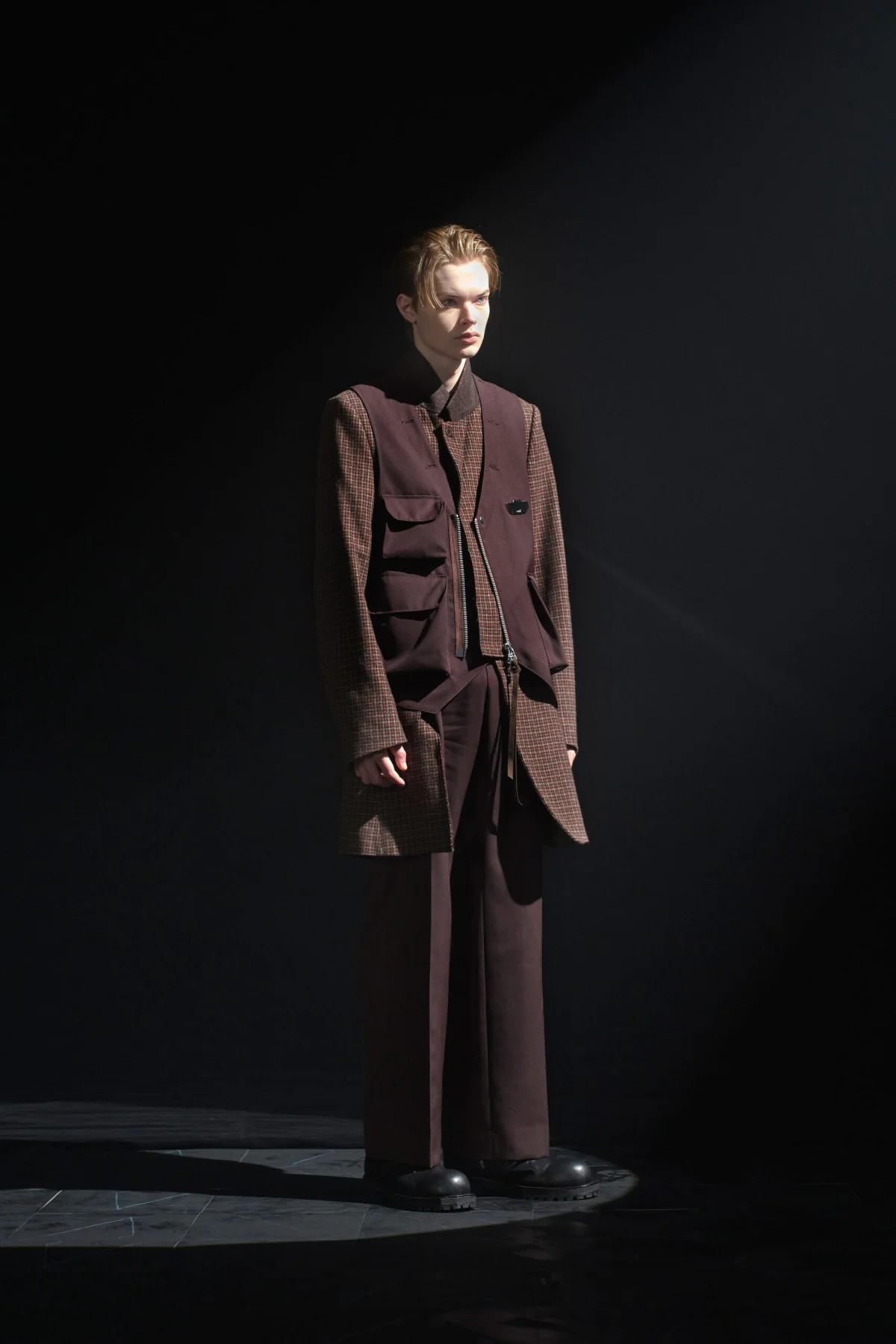
Tatsuya Tamada, the visionary founder and creative director of the Japanese label Tamme, has shifted the focus of his latest collection toward an exploration of power, discipline, and the structural integrity of the uniform. Speaking during a comprehensive showroom walkthrough in Tokyo, Tamada articulated a desire to deepen the public’s understanding of his brand’s core identity, which has historically oscillated between the rigid boundaries of military attire and the refined elegance of formalwear. By dissecting the traditional garments associated with authority—ranging from police tactical gear to mid-century military staples—Tamada has presented a collection that seeks to reconcile the imposition of discipline with the necessity of individual expression. This latest outing marks a significant milestone for the designer, who spent years refining his craft under the tutelage of industry icons before establishing Tamme as a distinct voice in the contemporary Japanese fashion landscape.
The Genesis of Tamme and the Philosophy of Reconstruction
To understand the trajectory of Tamme, one must look at the technical foundation laid by Tatsuya Tamada during his tenure at Sacai. Working for six years under Chitose Abe, a master of hybridity and deconstruction, Tamada developed a profound fluency in pattern cutting and the art of merging disparate garment archetypes. When he launched Tamme in 2021, the brand was built on the premise of "re-sequencing" existing clothing codes. The name itself, a combination of "Tamada" and "me," suggests a personal dialogue between the designer and the garments he recreates.
The current collection represents a maturation of this philosophy. Tamada’s obsession with uniforms is not merely aesthetic; it is rooted in the functional logic of clothing designed for specific roles. "Up until now, my design sources have been military and army-style items, military clothing, and formalwear. Uniforms, in other words," Tamada explained. However, rather than producing replicas, he utilizes his technical prowess to subvert the original intent of these garments. By breaking down the components of a uniform—the epaulettes, the utility pockets, the reinforced stitching—and reassembling them into silhouettes suitable for urban life, he strips the clothing of its coercive power and replaces it with a sense of personal agency.
Personal Narrative: From Fukushima to the Runway
The emotional core of the collection is inextricably linked to Tamada’s upbringing in Fukushima. His father, a police officer, served as his primary exposure to the concept of the uniform. In the designer’s memory, the transition his father made from a civilian to a representative of the law was facilitated by the clothing he wore. The "stompy" black boots and the crisp, baby-blue work shirts were more than just fabric; they were symbols of righteousness and societal order.
"Looking back, I think that was probably what made me think he was cool," Tamada reflected. This childhood wonder at how discipline could be "baked into fabric" has become the driving force behind his creative process. He views the uniform as a vessel for a specific type of "cool"—one that is derived from duty and structure rather than fleeting trends. By revisiting these memories, Tamada has infused the collection with a sense of nostalgia that balances the clinical precision of his tailoring.
Technical Breakdown: Splicing Tradition with Subversion
The collection’s strength lies in its ability to blend high-concept deconstruction with wearability. Several key pieces highlight Tamada’s ability to manipulate traditional forms:
- The Hybrid Trench: One of the most striking ensembles features what initially appears to be an indigo trench coat. Upon closer inspection, the garment reveals itself to be a complex layering of a jacket over a wrap skirt, constructed from durable yet refined textiles. This piece exemplifies the brand’s "half teenage rebellion, half SWAT team swagger" aesthetic.
- Knitwear Innovations: Ribbed cricket sweaters, a staple of traditional academic and athletic uniforms, were reimagined with contrasting cable knit detailing at the V-neck. The addition of a navy zip-pull in the center modernized the silhouette, moving it away from the collegiate and toward the utilitarian.
- Military Outerwear: Greige cargo jackets were elevated through the use of safety-orange linings, a direct reference to the MA-1 flight jackets used by the U.S. Air Force. This "inside-out" approach to military history allows the wearer to engage with the heritage of the garment while benefiting from a contemporary cut.
- Footwear Collaboration: In a partnership with the avant-garde label Kids Love Gaite, Tamada developed a spin on the Japanese police boot. Featuring geometric soles and silver front zips, the boots serve as a literal foundation for the collection’s theme of disciplined authority met with artistic eccentricity.
Chronology of Tamme’s Brand Evolution
The development of Tamme has followed a deliberate and strategic timeline, reflecting Tamada’s disciplined approach to business and design:
- 2015–2021: Tatsuya Tamada serves as a pattern maker at Sacai, contributing to some of the brand’s most critically acclaimed collections and honing his skills in complex garment construction.
- Spring/Summer 2021: Tamada officially launches Tamme, debuting with a collection that emphasizes the "re-sequencing" of military and tailored garments.
- 2022–2023: The brand gains traction in the Tokyo fashion scene, securing placements in prestigious boutiques and earning a reputation for its sophisticated take on the "utility" trend.
- Autumn/Winter 2024 (Current): Tamada expands the brand’s narrative to include personal history and a broader philosophical inquiry into the nature of power and uniforms.
Market Context and Industry Analysis
The rise of Tamme coincides with a broader global trend toward "utility-core" and "gorpcore," where functional, high-performance clothing is repurposed for luxury fashion. However, Tamada distinguishes himself by focusing on the "formal" side of utility. While many designers look to hiking gear or sportswear, Tamada looks to the state—the military and the police—for inspiration.
According to retail data from the Japanese luxury sector, there has been a 15% increase in consumer interest for "technical tailoring" over the past twenty-four months. Consumers are increasingly seeking garments that offer the durability of workwear with the prestige of high-fashion design. Tamme is well-positioned to capitalize on this demand. Industry observers note that Tamada’s background at Sacai provides him with a level of technical credibility that many emerging designers lack. "The market is currently saturated with ‘streetwear’ that lacks structural integrity," noted one Tokyo-based fashion consultant. "Tamada is providing a necessary counterpoint: clothing that is designed to last, both physically and aesthetically."
Broader Implications: The Authority of Dress
The collection arrives at a time when the symbolism of the uniform is under intense scrutiny. In a global political climate where authority and the institutions behind it are often viewed with skepticism or fear, Tamada’s decision to play with these symbols is a bold one. By "breaking down, substituting, or changing a uniform," Tamada argues that individuals can reclaim their identity from the structures that seek to homogenize them.
"I’ve given each piece its own will, with the idea that they can be worn and used completely freely," Tamada stated. This statement suggests that while the garments are born from a place of discipline, their ultimate purpose is liberation. The collection posits that individuality is not the absence of structure, but the ability to navigate and manipulate that structure to one’s own ends.
However, some critics suggest that the brand still has room to grow in terms of its world-building. While the clothes are "convincing and thoughtful," the narrative surrounding them remains somewhat tentative compared to the heavy-handed symbolism of the uniforms they reference. As Tamme continues to evolve, the challenge for Tamada will be to ensure that the "will" he gives his clothes translates into a clear and powerful brand universe that can stand alongside the historic institutions he draws from.
Future Outlook
Looking ahead, Tatsuya Tamada intends to expand Tamme’s reach beyond the Japanese market. Plans are reportedly in motion to increase the brand’s presence in European and North American showrooms, where the appetite for Japanese avant-garde tailoring remains strong. The success of this latest collection, with its blend of personal storytelling and technical mastery, suggests that Tamme is ready to move from a "designer’s brand" to a significant player on the international stage.
As the fashion industry continues to grapple with the balance between heritage and innovation, Tamada’s work serves as a reminder that the most powerful designs often come from a place of deep personal reflection. By looking back at his father’s blue shirts and black boots in Fukushima, Tatsuya Tamada has found a way to move forward, creating a new kind of uniform for an era that prizes individuality above all else. In the hands of Tamada, the clothing of the state becomes the clothing of the self, proving that even the most rigid structures can be reshaped by a creative will.

0 Comments