
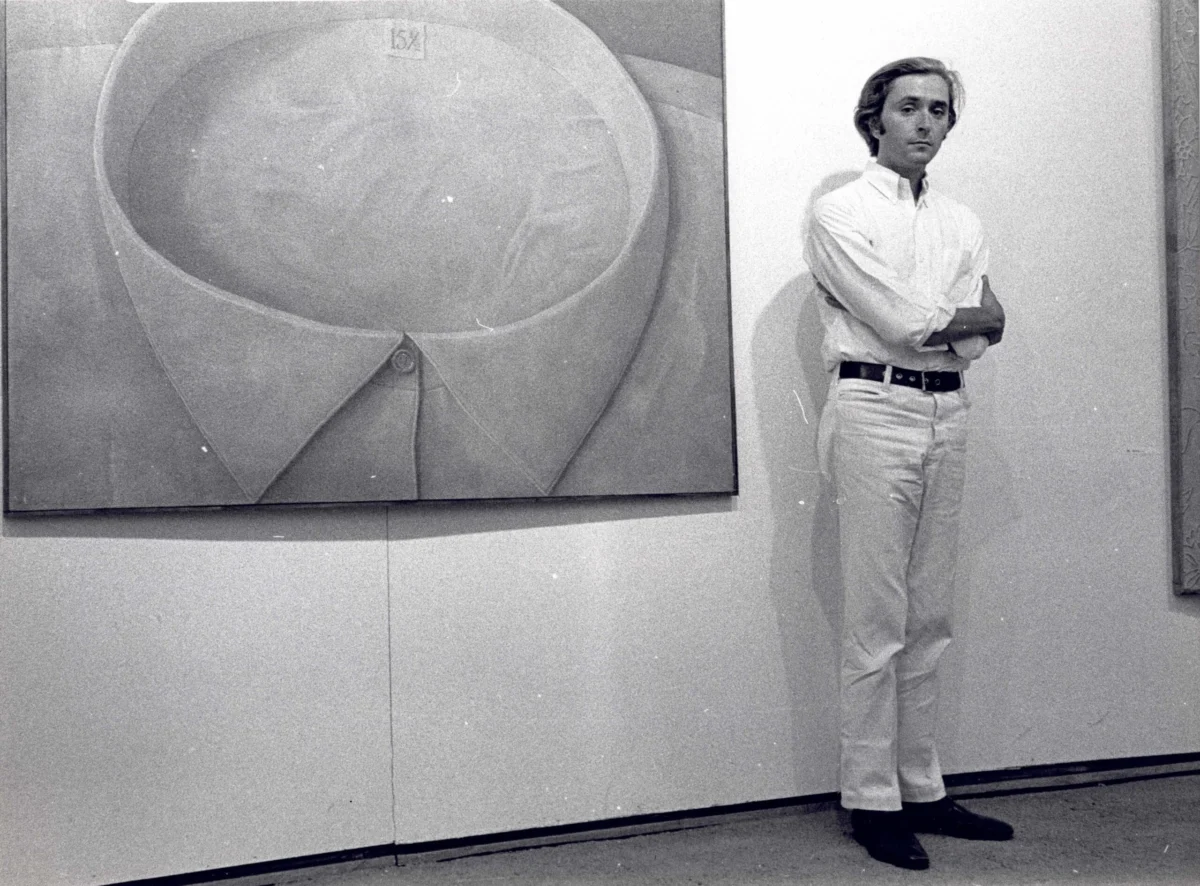
The landmark exhibition currently hosted at the Lévy Gorvy Dayan gallery in New York represents the most comprehensive American survey of Domenico Gnoli’s work in over five decades. Titled "The Adventure of Domenico Gnoli," the presentation features 17 seminal paintings alongside a curated selection of rarely seen drawings, etchings, notebooks, and personal correspondence. This exhibition marks a significant moment for the New York art world, as it is the largest presentation of Gnoli’s oeuvre in the United States since his 1969 solo show at the Sidney Janis Gallery, an event that occurred just months before the artist’s untimely death at the age of 36.

Domenico Gnoli remains one of the most enigmatic figures of 20th-century art. Born in Rome in 1933 into an intellectually distinguished family, he achieved early success as a stage designer and illustrator before pivoting to a singular style of painting that defied the prevailing categories of his time. His work occupies a unique intersection of Surrealism, Pop Art, and the Italian Arte Povera movement, characterized by an obsessive focus on the minute details of everyday life. The current exhibition focuses primarily on the zenith of his career between 1965 and 1969, a period during which he produced the majority of his mature paintings.
Technical Mastery and the Materiality of the Mundane
A defining characteristic of Gnoli’s work is his use of a meticulous trompe-l’oeil effect, which transforms ordinary objects into monumental sculptures. His subjects are often hyper-focused crops of sartorial or domestic items: the knot of a necktie, the curve of a shirt collar, the weave of a bedspread, or the undulating locks of hair. When viewed from a distance, these works appear almost abstracted, but upon closer inspection, they reveal a rigorous attention to texture and form.
.%2520Private%2520Collection%2C%2520courtesy%2520of%2520HomeArt.%2520courtesy%2520of%2520Le%25CC%2581vy%2520Gorvy%2520Dayan%2C%2520New%2520York%2520%25C2%25A9%25202026%2520Artists%2520Rights%2520Society%2520(ARS)%2C%2520New%2520York_SIAE%2C%2520Rome.jpg)
Gnoli’s technical process was as unique as his subject matter. During his years living in Majorca, Spain, he developed a signature method of mixing acrylic pigments with sand sourced from local beaches and vinyl glue. This mixture was applied to the canvas to create a grainy, fresco-like surface that provided a three-dimensional quality to his depictions of fabric and hair. In works such as Il grande letto azzurro (1965), this technique is utilized to render a teal bedspread where the floral patterns are composed of non-pigmented sand, creating a tactile experience for the viewer that bridges the gap between painting and relief sculpture.
This focus on "the magic of the object’s presence," as Gnoli described it, was a deliberate move away from the gestural abstraction that dominated the mid-century art scene. By isolating details—a zipper, a button, or the back of a shoe—Gnoli elevated the quotidian to the level of the heroic, forcing a meditative engagement with the material world.

A Chronology of a Brief but Prolific Career
To understand the impact of the current exhibition, one must examine the rapid trajectory of Gnoli’s life and the various cultural spheres he inhabited.
- 1933–1950: Formative Years in Rome. Born to Umberto Gnoli, an esteemed art historian and museum curator, and Annie de Garrou, a ceramicist, Gnoli was immersed in the arts from birth. His grandfather and namesake was a celebrated poet. This lineage provided him with a deep appreciation for classical art history, which would later inform his precise, almost Renaissance-like draftsmanship.
- 1950s: The Illustrator and Designer. Gnoli initially gained international recognition as an illustrator for major publications such as Sports Illustrated, Life, and Fortune. He also established himself as a prominent costume and set designer for the theater, working on productions in Rome, London, and Zurich.
- 1955: The Move to New York. Gnoli’s first trip to New York proved pivotal. He felt that the city, along with Paris, was one of the few places where an artist could truly develop. During this period, he integrated into the city’s intellectual circles, eventually befriending influential figures such as legendary Vogue editor Diana Vreeland.
- 1962–1965: Transition to Mature Painting. After living in Paris, Gnoli moved to Majorca with his second wife, the artist Yannick Vu. It was here that he abandoned his previous illustrative style in favor of the large-scale, macro-focused paintings of objects that would define his legacy.
- 1969: The Sidney Janis "Consecration." Gnoli returned to New York for a solo exhibition at the Sidney Janis Gallery. The show was a critical and commercial triumph, attended by the elite of the New York art and fashion worlds.
- 1970: Untimely Passing. Just as he reached the height of his fame, Gnoli died of cancer in April 1970 at the age of 36.
The "Cult of Gnoli" and Market Scarcity
The rarity of Gnoli’s work contributes significantly to the intensity of interest surrounding the Lévy Gorvy Dayan exhibition. It is estimated that only 160 to 170 mature paintings by Gnoli exist. Because he died so young and at the peak of his career, the vast majority of these works were immediately acquired by private collectors and have rarely returned to the secondary market.

Amalia Dayan, co-founder of the gallery, notes that Gnoli’s collectors are famously reluctant to part with his works, even for temporary museum loans. Many pieces have remained within the same families for decades, passed down through generations. This scarcity has created what insiders call the "Cult of Gnoli"—a dedicated group of admirers and collectors, including fashion icon Miuccia Prada and her husband Patrizio Bertelli, who view his work with an almost obsessive reverence.
The logistical challenge of assembling 17 major paintings for this exhibition required extensive collaboration with the artist’s estate. This includes the Domenico Gnoli Archives in Majorca, led by Yannick Vu and her husband Ben Jakober, and the Archivio Domenico Gnoli in Rome, led by the artist’s sister, Mimì Gnoli. The inclusion of ephemeral materials—letters, notebooks, and drawings—serves to provide a psychological map of an artist who worked with a "fabulous visual memory," often painting from recollection rather than life.
.%2520Private%2520Collection%2C%2520courtesy%2520of%2520Le%25CC%2581vy%2520Gorvy%2520Dayan%2C%2520New%2520York%2520%25C2%25A9%25202026%2520Artists%2520Rights%2520Society%2520(ARS)%2C%2520New%2520York_SIAE%2C%2520Romejpg.jpg)
Institutional Recognition and Contemporary Influence
While Gnoli was highly regarded during his lifetime, his reputation has seen a massive resurgence in the 21st century. A significant turning point was the 2021–2022 retrospective at Fondazione Prada in Milan, which featured over 100 paintings and 100 drawings. That exhibition solidified his status as a master of post-war European art and highlighted his influence on subsequent generations of artists.
Contemporary painters have increasingly cited Gnoli as a foundational influence. Anna Weyant, a prominent figure in the current New York art scene, has expressed admiration for Gnoli’s "restraint" and his ability to turn mundane scenes into "magnetic and psychologically charged images." Observers have noted stylistic parallels between Gnoli’s hair paintings, such as Curly Red Hair (1969), and Weyant’s own meticulous portraits. Similarly, the work of Issy Wood, known for her close-up renderings of garments and textures, echoes Gnoli’s focus on the semiotics of clothing.

His influence extends beyond painting into the realm of conceptual art. Maurizio Cattelan’s 2007 work All, featuring marble sculptures of bodies under sheets, is frequently compared to Gnoli’s "bed paintings." In works like Il grande letto azzurro, Gnoli explored the bed as a site of the entire human cycle—birth, intimacy, and death—through the presence of an empty, meticulously rendered spread. This manipulation of "presence and absence" remains a core theme in contemporary art dialogues.
Broader Impact and Implications for the Art World
The "Adventure of Domenico Gnoli" serves as more than just a retrospective; it is a call for a broader reassessment of Gnoli’s place in the canon of 20th-century art. Despite his profound connection to New York and his success at the Sidney Janis Gallery, Gnoli has yet to receive a major solo retrospective at a premier American museum, such as the Museum of Modern Art or the Metropolitan Museum of Art.
.%2520Private%2520Collection%2C%2520courtesy%2520of%2520HomeArt.%2520courtesy%2520of%2520Le%25CC%2581vy%2520Gorvy%2520Dayan%2C%2520New%2520York%2520%25C2%25A9%25202026%2520Artists%2520Rights%2520Society%2520(ARS)%2C%2520New%2520York_SIAE%2C%2520Rome.jpg)
The success of the Lévy Gorvy Dayan exhibition suggests that the American public and institutional curators are ready for such a reassessment. By presenting Gnoli’s work in the heart of New York, the gallery re-establishes the artist’s link to the city that he considered essential for his development. The exhibition also highlights the enduring relevance of "slow looking." In an era dominated by rapid digital consumption, Gnoli’s canvases demand a physical presence and a time-intensive engagement to appreciate the nuances of his sand-inflected surfaces and the precision of his lines.
As the exhibition concludes its run, the legacy of Domenico Gnoli appears more secure than ever. His ability to find the extraordinary within the ordinary, and his commitment to technical perfection despite the brevity of his career, continues to resonate. For a new generation of New York viewers, "The Adventure of Domenico Gnoli" offers a rare opportunity to step into a "complex universe" where a simple tie knot or a ruffled bedsheet is granted the gravitas of a historical monument. Through this survey, Gnoli is once again recognized not just as a cult favorite, but as a pivotal master whose work remains timelessly modern.

0 Comments