
The live music landscape witnessed a significant cultural and philanthropic milestone this week as the inaugural Daisy Chain Festival convened at Daisy Chain Fields, marking a high-profile convergence of pop-star influence, feminist activism, and substantial charitable giving. Founded by Grammy-winning artist Olivia Rodrigo, the festival drew thousands of attendees who braved extreme meteorological conditions, with temperatures exceeding 103 degrees Fahrenheit, to participate in an event designed as a modern successor to the female-led touring festivals of the 1990s. Beyond the musical performances, the event served as a massive fundraising vehicle, generating $10 million in proceeds that were subsequently doubled by philanthropist Melinda French Gates, resulting in a $20 million windfall for ten non-profit organizations dedicated to supporting women and girls.

The festival’s debut comes at a pivotal moment in the music industry, where major artists are increasingly leveraging their platforms to address socio-political issues. By centering the event on a women-led lineup and a mission-driven financial structure, Rodrigo has positioned Daisy Chain as a flagship for cause-based entertainment. The presence of Sarah McLachlan, the founder of the historic Lilith Fair, further underscored the festival’s lineage, bridging the gap between the feminist "Riot Grrrl" movements of the past and the contemporary "pop-activism" of the 2020s.
Philanthropic Impact and Financial Structure
The financial success of Daisy Chain represents one of the most significant single-day charitable contributions tied to a music festival in recent years. The initial $10 million raised through ticket sales, sponsorships, and merchandise was bolstered by a strategic partnership with Melinda French Gates, whose matching contribution brought the total to $20 million. This capital is slated for distribution among ten pre-selected non-profit organizations. While the specific list of beneficiaries remains under formal review for long-term auditing, organizers confirmed the funds would focus on reproductive healthcare access, STEM education for girls, and domestic violence prevention initiatives.

Melinda French Gates’ involvement signals a broader trend of "venture philanthropy" entering the entertainment space. By doubling the festival’s proceeds, Gates has validated the festival’s model as an effective mechanism for large-scale resource mobilization. Industry analysts note that this model—where a high-net-worth individual matches the collective "purchasing power" of a fan base—creates a powerful incentive for consumer participation, as fans feel their ticket purchase has a direct, tangible impact on social causes.
A Lineup Rooted in Feminist History and Modern Pop
The curation of the Daisy Chain lineup was intentionally designed to honor the history of women in rock and pop while highlighting the genre-bending stars of the current era. Headliner and founder Olivia Rodrigo was joined by a diverse array of artists, including Chappell Roan, Doechii, and the legendary punk band Bikini Kill. The inclusion of Bikini Kill, a cornerstone of the 1990s Riot Grrrl movement, served as a bridge between generations, emphasizing the festival’s themes of female empowerment and systemic critique.

The festival also featured significant guest appearances from icons such as Stevie Nicks and Alanis Morissette. However, the most symbolic appearance was that of Sarah McLachlan. Rodrigo has frequently cited McLachlan and the Lilith Fair—which ran from 1997 to 1999 and became the top-grossing touring festival of its time—as the primary inspiration for Daisy Chain. McLachlan’s presence provided a "passing of the torch" moment, legitimizing Rodrigo’s effort to revive the concept of an all-female festival circuit for a new generation of listeners.
Fashion as a Medium for Identity and Protest
The attendees of Daisy Chain utilized fashion as a primary means of expressing the festival’s core values. Despite the oppressive heat, the "festival regalia" was a sophisticated mix of aesthetic trends and political signaling. Observers noted that the "babydoll dress"—a garment popularized by Rodrigo during her You Look Pretty Sad for a Girl So in Love era—emerged as the dominant sartorial choice. The dress, often paired with heavy leather boots, serves as a visual shorthand for the "soft-grunge" and "hyper-feminine" duality that characterizes the current pop-feminist landscape.

Interviews with attendees revealed a deep connection between their clothing and their personal identities. Amaya, a 23-year-old attendee, described her thrifted babydoll dress as a deliberate nod to Rodrigo’s aesthetic, while her companion, Julia, explained the "layered logic" behind their matching blue eyeshadow and feminine attire. "We wanted to give babydoll. Riot grrrl, but we’re sweet," Julia stated, noting that their fashion choices were a way of "questioning gender identities" through the lens of music and style.
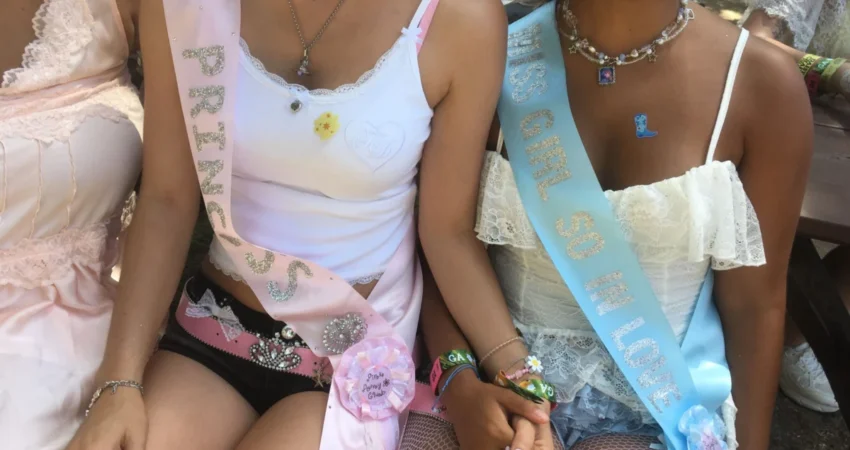
Another segment of the crowd, inspired by the "high-camp" fantasy of Chappell Roan, adopted a more theatrical approach. Fans were seen in pageant sashes and cone-shaped princess hats, a direct homage to Roan’s The Rise and Fall of a Midwest Princess album. Nicole, a 21-year-old from Sonoma County, hand-crafted sashes for her group, stenciling the names of their favorite tracks by Roan and Rodrigo onto the fabric. This "fandom-as-fashion" movement illustrates how modern audiences use clothing to signal their allegiance to specific artistic subcultures.

Regional Homages and Generational Legacies
The festival also attracted fans who used the platform to honor their geographical and familial roots. Grace and Logan, two students who recently moved to California from Whitefish, Montana, arrived in attire that reflected their Western heritage. Logan wore cowboy boots typically used for line dancing and a leather vest from Depop, explaining that the look was an homage to their life back home.
For many younger attendees, the feminist themes of the festival were a continuation of their upbringing. Francine, an 18-year-old from Fresno, attributed her style inspiration to the Riot Grrrl movement she was introduced to by her mother. Growing up with Bikini Kill and Jack Off Jill on the stereo—and even a punk album cover on her nursery wall—Francine’s presence at Daisy Chain represented the multi-generational reach of feminist punk music.

Logistical Challenges: Managing Extreme Heat
The primary operational challenge for the Daisy Chain organizers was the extreme heatwave affecting the region. With temperatures climbing past 103 degrees, festival staff were tasked with ensuring the safety of thousands of attendees in an open-field environment. The heat forced many fans to prioritize function over form; for example, Ella, 26, utilized a paisley headscarf to manage the temperature, while others, like Holden from Kansas City, abandoned complex layering in favor of breathable fabrics.
Organizers responded by deploying high-capacity cooling stations, water refill points, and a media shuttle system to minimize long-distance walking in the sun. Despite the weather, the "amazing vibes"—a term frequently used by attendees to describe the collective spirit of the event—remained intact. The resilience of the crowd suggested a high level of commitment to the festival’s mission, with many fans traveling from across the country specifically to support the female-led bill.

Broader Implications for the Festival Industry
The success of Daisy Chain suggests a potential shift in the economics of large-scale music events. For years, the festival industry has faced criticism for male-dominated lineups and a perceived lack of social responsibility. Rodrigo’s model challenges this status quo by proving that a festival focused exclusively on female and non-binary artists can be both a commercial success and a philanthropic powerhouse.
Furthermore, the involvement of major philanthropists like Melinda French Gates indicates that music festivals may become increasingly integrated with global development goals. By directing $20 million toward women’s causes, Daisy Chain has set a new benchmark for how entertainment events can serve as catalysts for social change.

Conclusion and Future Outlook
The inaugural Daisy Chain Festival has established itself as more than just a musical event; it is a cultural phenomenon that blends the nostalgia of 90s feminism with the digital-age influence of Gen Z pop stars. The combination of high-profile performances, a clear political and social mission, and significant financial backing has created a blueprint that other artists may seek to emulate.
As the festival concludes its first year, the focus turns to the long-term impact of the $20 million donation. The success of the ten non-profits receiving these funds will likely be a key metric in evaluating the festival’s ultimate legacy. For now, Daisy Chain stands as a testament to the power of a "feel-good" mission to unite a diverse audience, even in the face of record-breaking heat and a complex socio-political climate. Olivia Rodrigo’s vision of a modern Lilith Fair has not only materialized but has done so with a financial and cultural weight that promises to resonate for years to come.

0 Comments