
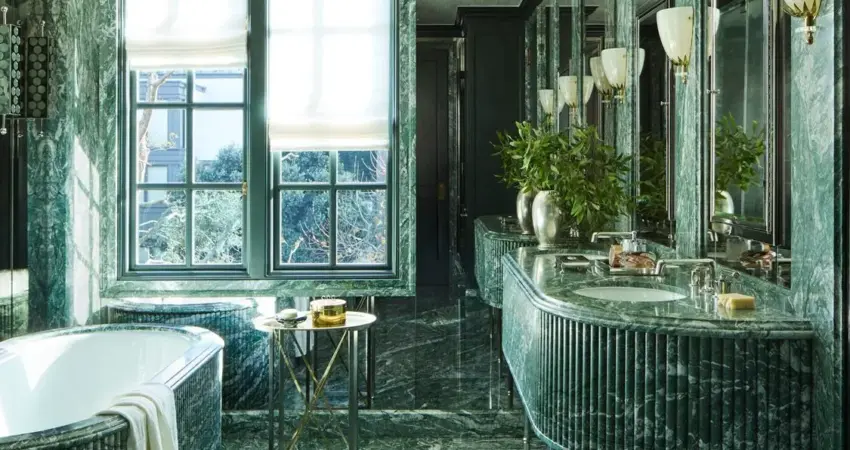
The era of the ubiquitous, minimalist "spa bathroom"—characterized by its sterile palette of gray and white, abundant natural light, and expansive slabs of Calacatta Viola marble—appears to be yielding to a more opulent and visually arresting aesthetic. This evolving design trend signals a significant departure from the subdued elegance of recent years, ushering in an era of bold material choices, dramatic textures, and a renewed appreciation for the architectural artistry of the past. The contemporary iteration of the luxurious bathroom embraces richly veined stones in deep emerald greens and dusky reds, artfully sculpted fixtures reminiscent of the Art Deco period, and the warm, sophisticated embrace of fine woodwork. This dramatic shift draws direct inspiration from the groundbreaking designs of 1930s Milan, a period when utilitarian spaces were transformed into breathtaking showpieces through audacious material combinations and meticulous geometric precision.

A Legacy of Bold Design: Piero Portaluppi’s Enduring Influence
Central to this design renaissance is the enduring legacy of Piero Portaluppi (1888–1967), a seminal figure of Italian Rationalist architecture. While Portaluppi’s grand architectural gestures, such as the iconic Villa Necchi Campiglio and Casa Corbellini-Wassermann, have long captivated designers with their dramatic entryways and sweeping staircases, it is his innovative approach to bathrooms that is currently experiencing a significant cultural moment. These intimate spaces, often overlooked in architectural discourse, are now being recognized for their daring material applications and sophisticated detailing, offering a compelling blueprint for contemporary luxury.
Portaluppi’s masterful use of stone is particularly evident in his Milanese residential projects. At Villa Necchi Campiglio, a masterpiece of 1930s Italian modernism, mirrored walls amplify the mesmerizing, swirling patterns of Arabescato Orobico marble, creating an almost hallucinatory effect. This deliberate use of reflection not only expands the perceived space but also intensifies the visual impact of the stone’s natural beauty. In a similar vein, at the nearby Casa Corbellini-Wassermann, Portaluppi juxtaposed the vibrant, intense hue of Verde Challant marble with the stark, graphic presence of black stonework. This deliberate contrast generated a dynamic tension, transforming the bathroom into a space of unexpected visual intrigue.

The Power of Juxtaposition: Lessons from Milanese Masters
Interior designer Athena Calderone, a prominent figure in the contemporary design scene, has openly acknowledged the profound influence of Portaluppi’s work on her own design philosophy. Calderone, who visited Villa Necchi with architect Danielle Siggerud while undertaking the redesign of her Tribeca apartment, noted the strategic brilliance of Portaluppi’s material choices. "He frequently used contrasting materials to frame hallways, thresholds, and architectural elements, allowing these moments of juxtaposition to draw the eye and bring a sense of ceremony to the space," Calderone explained. This approach, she suggests, imbues even the most functional areas of a home with an elevated sense of purpose and aesthetic sophistication.
The impact of this design sensibility is further exemplified in the work of AD100 designer Gregory Rockwell. Rockwell expresses a strong affinity for Portaluppi’s unconventional and courageous color palettes. "What I love about Portaluppi is how controlled everything is architecturally, but then he’ll do something extravagant with the marble or an unexpected color," Rockwell stated. This balanced approach—marrying architectural restraint with bold material statements—is a hallmark of the new wave of luxury bathrooms.

Rockwell, alongside colleague Hester Hodde, applied this philosophy to the primary bathroom of supermodel Paloma Elsesser’s Brooklyn townhouse. The result was a daring and harmonious blend of textures and colors: rich burgundy Rosso Francia marble was paired with warm walnut-and-mirror paneling, all set against a backdrop of soothing pistachio-green walls. "It’s a slightly strange combination when you think about it, but I love the colors together," Rockwell admitted, underscoring the success of this unexpected yet captivating material synergy. This project, featured in Architectural Digest, highlights the growing trend of embracing unique material pairings to create personalized and memorable interior spaces.
Embracing Irregularity: A Departure from Perfection
Athena Calderone’s personal approach to bathroom design further illustrates the contemporary interpretation of Portaluppi’s genius. For her own primary bathroom, Calderone meticulously incorporated sweeping expanses of pale stone, artfully edged with intricate inlaid tile borders. This detailed craftsmanship, combined with fixtures and geometric mirrors infused with Art Deco sensibilities, creates a space that is both luxurious and deeply personal. Reflecting on Portaluppi’s techniques, Calderone observed a significant divergence from current prevailing trends: "There was such ingenuity in the way Portaluppi clad entire bathrooms in stone, often using smaller, individually composed pieces. It feels almost at odds with how we approach stone today, where expansive, perfectly bookmatched slabs have become the prevailing ideal. He embraced the irregularity and variation in the veining."

This appreciation for the inherent uniqueness of natural stone is also evident in Calderone’s powder room, which features a custom pedestal sink crafted from deeply veined Verde Alpi marble. The stone’s rich green tones and dramatic veining make it a focal point, demonstrating that even smaller spaces can achieve a high level of design impact through thoughtful material selection. This emphasis on the natural character of stone, rather than striving for absolute uniformity, resonates with a growing desire for authenticity and handcrafted beauty in interior design.
Reinterpreting the Past for the Present
The influence of 1930s Milanese design is not confined to bespoke residential projects; it is actively shaping the offerings of bath fixture and tile manufacturers. New collections are emerging that draw directly from the vocabulary of Portaluppi’s bathrooms, providing designers and homeowners with accessible ways to incorporate patterned stone, geometric forms, and rich colors without undertaking a complete renovation.

Artistic Tile’s Calacatta Gold marble mosaic, for instance, offers a contemporary rendition of the intricate inlaid tile borders that characterized Calderone’s interpretation of Portaluppi’s work, bringing a touch of artisanal complexity to walls and floors. Similarly, Kelly Wearstler’s Treillage tile collection for Ann Sacks, in a striking oxblood hue, provides a dimensional take on the rich burgundy tones seen in Paloma Elsesser’s bathroom, allowing for the incorporation of this opulent color in a more manageable format.
Clé Tile, in collaboration with Reath Design, has introduced marbleized patterns that artfully capture the dynamic movement and visual depth of natural stone, offering a visually compelling alternative to solid stone surfaces. The influence extends to smaller, decorative details as well. Charles Edwards’ alabaster dish light features an elegant Art Deco-inspired silhouette, adding a touch of vintage glamour. Meanwhile, Crate & Barrel’s Verde Green marble soap pump and tissue holder bring the distinctive color and veining of Verde Alpi marble, reminiscent of the sinks found in contemporary interpretations of Portaluppi’s designs, to the countertop scale, making this trend accessible for even the smallest bathroom updates.

A Philosophy of Beauty and Excitement
The underlying philosophy driving this shift towards more dramatic and richly appointed bathrooms is a fundamental belief in the importance of aesthetic integrity throughout the entire home. As Gregory Rockwell succinctly puts it, "I’ve never really understood why bathrooms should be any less interesting than the rest of the house. They might as well be beautiful and exciting." This sentiment underscores a broader recognition that bathrooms are no longer merely functional spaces but are integral components of a home’s overall design narrative, deserving of the same level of creativity, craftsmanship, and material luxury as any other room.
The resurgence of the dramatic Italian bathroom, inspired by the pioneering work of architects like Piero Portaluppi, signifies a move away from the era of understated minimalism. It is a celebration of bold material expression, intricate detailing, and the timeless allure of rich colors and textures. Whether achieved through an entire room clad in statement-making marble or a single, well-chosen accent, this trend reflects a desire to infuse everyday spaces with an enduring sense of beauty, drama, and personal style. The 1930s Milanese aesthetic, with its emphasis on bold juxtapositions and architectural precision, continues to offer a compelling vision for the modern luxury bathroom, proving that timeless design principles can indeed be reinterpreted to create spaces that are both sophisticated and exhilarating.

0 Comments