
The digital landscape for interior design professionals is undergoing a significant transformation, with Substack emerging as a powerful new platform for content creation, audience engagement, and brand building. Once primarily dominated by visual social media like Instagram, the design industry is increasingly recognizing the value of long-form, personality-driven content delivered directly to subscribers via email newsletters. This shift, accelerated by a growing desire for more authentic and in-depth content, is allowing designers to cultivate deeper relationships with their audiences and establish a more robust online presence.
Substack’s Growing Influence in the Design Sphere
The surge in Substack newsletters across various industries has not bypassed the design world. While Instagram has long served as a visual portfolio and networking hub, many creators and consumers are experiencing a degree of platform fatigue. Substack offers a compelling alternative, providing a space for more detailed narratives, personal insights, and opinions that might not fit the curated aesthetic of traditional social media.

Among the prominent figures embracing this new medium is AD100 Hall of Fame designer Kelly Wearstler, who launched her newsletter, Wearstlerworld, in December 2024. Within a short period, she has amassed over 42,000 subscribers, positioning herself as a leading voice in the design-focused Substack community. Following suit, AD100 designer and television personality Jeremiah Brent announced his debut on the platform last summer, offering his subscribers exclusive content. Stylist Colin King also entered the fray in September with The Last Layer, his dedicated interior design Substack.
The appeal of Substack extends beyond established celebrities. Emerging design studios are also recognizing the strategic advantage of this platform. They are dedicating resources and developing content strategies to carve out their niche, aiming to leverage the direct communication channel to connect with potential clients, collaborators, and industry peers. This growing adoption raises a critical question for many: is the investment in building a Substack newsletter truly worth the effort and resources required?
Understanding the Substack Model: Monetization and Value Proposition
At its core, Substack operates on a straightforward monetization model that is accessible to creators. The platform is free to join, allowing individuals to establish their digital presence. Creators have the option to implement paywalls for certain content, such as articles, subscriber-only comment sections, and direct chat features that facilitate interaction between authors and their readers. Substack retains 10 percent of the subscription revenue generated by its users, with an additional 3 percent taken by Stripe, the platform’s payment processor. Beyond written content, Substack supports the hosting of podcasts, videos, and informal "Notes" – akin to microblogging posts. Furthermore, creators can integrate affiliate links into their posts, earning a commission on sales generated through their recommendations. Tools like ShopMy are frequently utilized by Substackers for this purpose. While Substack currently lacks a built-in advertising network, the company has indicated that it is exploring such possibilities.

The primary benefit for creators on Substack is the acquisition of owned content and, crucially, an owned audience. As Colin King emphasizes, "For any business or brand, owning your email list is incredibly valuable." Unlike the ephemeral nature of social media feeds, Substack grants creators direct access to subscriber data, empowering them to manage their outreach and communication strategies. King elaborates, "Instagram can change the rules tomorrow. Algorithms come and go. But an email list is direct. I can actually reach the people who want to hear from me." This direct line of communication fosters a sense of community and loyalty, independent of the fluctuating policies and algorithms of larger social media platforms.
Cultivating an Engaged Audience: The Long Game of Digital Connection
The audience built through Substack is a significant asset, potentially comprising future clients, valuable collaborators, strategic partners, and influential referral sources. Brad Thornton, an interior designer and founder of the Substack Can I Move That?, launched his newsletter two months ago and highlights its strategic advantage. "From a brand perspective, it adds a distribution channel with longer tail conversion," he explains. This signifies that while the immediate impact might not be substantial, the persistent nature of email newsletters and web-hosted content offers enduring discoverability. Unlike algorithmic feeds, Substack content can be found and revisited over time, providing a sustained avenue for engagement and lead generation.
The longevity of content on Substack has already demonstrated its value. Cola Studios, a New York City-based interiors firm founded by Sam Colamussi and Olya Dmitrieva, launched their eponymous Substack two years ago to address what they perceived as a gap in the design content landscape. At the time, existing "Design Substacks" predominantly focused on DIY projects, while Cola Studios aimed to delve into opinions on interiors, industry events, and the broader discourse surrounding design media. They opted to keep their content free and accessible, viewing their newsletter as a vital marketing tool. "We look at this as a marketing tool and a way for people to get to know us, both potential clients and within the industry," states Colamussi. Through their Substack, they have successfully connected with editors, writers, business collaborators, and fellow creatives. Most notably, a recent reader interaction has evolved into a secured paid design project, underscoring the tangible business development potential of the platform.

The Demands of Content Creation: A Significant Time Commitment
While the benefits of Substack are clear, the platform also presents a demanding content creation cycle. Cola Studios, in their initial year, produced weekly opinion essays, curated product roundups, mood boards, and news and culture coverage. This ambitious pace proved unsustainable. They have since adjusted to producing two substantial stories per month, a commitment that still requires considerable effort. Colamussi describes it as a "second job," with both partners dedicating substantial hours to maintain the newsletter’s momentum. Colin King also invests significant time, dedicating approximately 10 to 15 hours per week to his twice-weekly newsletter.
Navigating the Investment: Return on Engagement Over Direct Revenue
For the majority of Substack authors, the primary return on investment is not derived from subscription revenue alone. Sean Low, a creative business consultant and host of The Business of Being Creative podcast, notes that "Building an audience that will pay at a mass level is a ton of work and requires consistency and longevity." Similarly, affiliate revenue, while present, is often a scale-dependent play. Without a substantial subscriber base, earnings from platforms like ShopMy are typically modest. However, the value of familiarizing an engaged readership with a creator’s unique perspective and creative philosophy is substantial.
"It saves everyone a lot of polite circling," King observes. "Clients now come in already understanding how I think about rooms. Brands have a clearer sense of the kinds of objects I care about and why." Thornton echoes this sentiment, stating, "It elevates the starting point," which has led to more productive and informed discussions with potential clients.

While platforms like Instagram excel as a visual "shop window" for a designer’s aesthetic, Substack provides the space to articulate the "why" and "how" behind creative decisions. Brent posits that Substack complements visual platforms by slowing down the narrative. "Substack has been complementary in that it slows everything down," he says. "It allows for depth where Instagram often prioritizes what’s short and sweet and visual." This distinction is crucial for designers seeking to convey a deeper understanding of their craft and their individual approach.
Embracing Authenticity: Channeling the Spirit of Anthony Bourdain
Across the board, contributors to this discussion agree that authenticity is paramount for success on Substack. Sean Low advises against creating another platform for "puffery," drawing a parallel with the impactful communication style of the late Anthony Bourdain. "The beauty of Anthony Bourdain and why he mattered so much was that we saw how food shapes culture and vice-versa—how his opinions on the experience shaped him," Low explains. "This is what Substack can bring designers if they have the courage to go there."
There exists a delicate balance between sharing personal insights and veering into excessive oversharing, which Thornton terms "climbing cringe mountain." However, the inherent nature of Substack often feels less pressured than more polished platforms like Instagram, potentially lowering the perceived stakes for vulnerability.

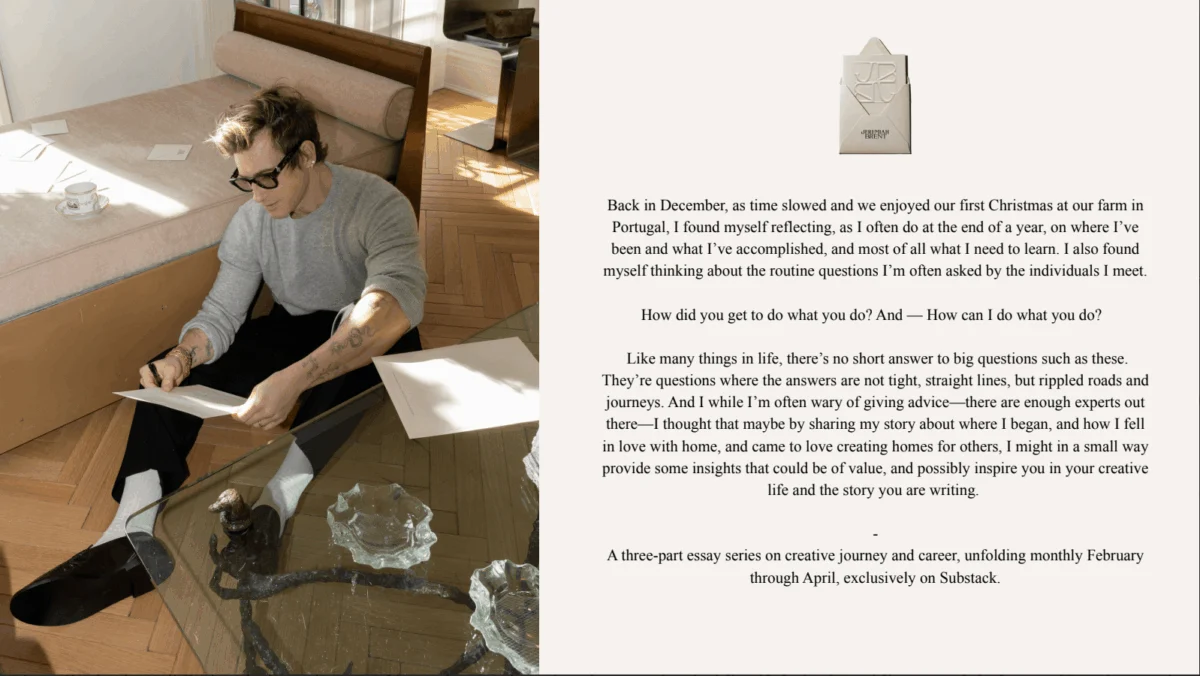
Jeremiah Brent has openly embraced this intimacy, finding Substack to be a unique channel for personal storytelling. He describes his Substack contributions as "the longest and most personal form of writing I’ve shared publicly," likening the experience to "opening something that wasn’t necessarily meant for everyone." Given the public nature of his life, Brent sees value in curating a more intimate space for his most personal reflections, reserved for a dedicated and invested audience. His newly launched Substack features a three-part personal essay titled "Letters from Jeremiah Brent," illustrating this approach to deeper, more reflective content.
Ultimately, Substack is not a quick financial fix for designers. Its true payoff lies in the ownership of one’s narrative, the creation of an enduring archive, the prequalification of clients, and the opportunity to showcase the often-unseen process of creative work. The rewards are a slower burn: the cultivation of better-matched clients and stronger, more meaningful professional relationships. However, achieving these outcomes requires a significant investment of time, consistent writing, and a willingness to embrace vulnerability. For designers prepared to make this commitment, Substack presents a compelling avenue for growth and deeper connection in the digital age.

0 Comments