
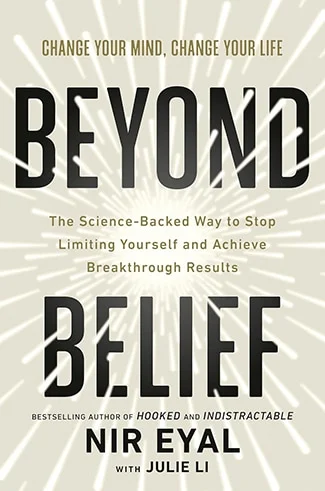
In a detailed exploration of human potential and cognitive psychology, behavioral design expert Nir Eyal recently appeared on the Art of Manliness podcast to discuss the internal frameworks that dictate individual success and failure. Eyal, the author of the new book Beyond Belief: The Science-Backed Way to Stop Limiting Yourself and Achieve Breakthrough Results, argues that the primary obstacles preventing people from achieving their goals are rarely environmental or physical. Instead, he posits that "invisible limits"—deeply ingrained psychological beliefs—act as the ultimate ceiling on performance.
The discussion provides a synthesis of neuroscience and behavioral psychology, challenging the traditional view that progress is solely a matter of external resources or sheer willpower. By examining how internal narratives shape biological responses and cognitive focus, Eyal offers a roadmap for identifying and dismantling the mental barriers that sabotage long-term objectives in both professional and personal spheres.
The Evolution of Behavioral Science: From Habits to Beliefs
The conversation marks a significant pivot in the career of Nir Eyal, who rose to prominence with his analysis of habit formation in Hooked and his strategies for focus in Indistractable. While his previous work focused on external triggers and time management, his current research delves into the foundational beliefs that precede action. Eyal suggests that even the most robust productivity systems fail if an individual’s underlying belief system is calibrated for limitation.
The core premise of Eyal’s research is that the human brain operates as a "prediction engine." When an individual believes a task is impossible or that they lack a specific talent, the brain filters out information that contradicts this view and prioritizes data that confirms it. This phenomenon, often referred to in psychology as "motivated reasoning" or "confirmation bias," creates a self-fulfilling prophecy where the perceived limit becomes a functional reality.
The Framework: Deciphering the Three Powers of Belief
Central to the discussion is Eyal’s framework of the "Three Powers of Belief." This structure explains how internal narratives influence the physiological and psychological mechanisms required for achievement.
1. The Power of Attention
Eyal explains that belief dictates what the brain chooses to notice. In a world of infinite stimuli, the brain must filter information. If a person believes they are "bad with money," their reticular activating system (RAS)—a bundle of nerves at our brainstem that filters out unnecessary information—will likely ignore opportunities for investment or savings, focusing instead on the stress of bills. By shifting the underlying belief, an individual can "prime" their brain to identify opportunities that were previously invisible.
2. The Power of Expectation
Drawing on the "Expectancy Theory" of motivation, Eyal describes how the anticipation of an outcome influences the effort exerted. If the expected outcome is failure, the brain instinctively conserves energy, leading to "half-hearted" attempts that inevitably fail. This reinforces the original limiting belief. Conversely, a high expectation of success triggers the release of dopamine, which provides the cognitive "fuel" necessary to persist through the "dip"—the difficult middle phase of any major project.
3. The Power of Agency
Agency refers to the belief that one has the power to affect change in their own life. Eyal notes that a lack of agency is often manifested as "learned helplessness," a term coined by psychologist Martin Seligman. When individuals believe their circumstances are fixed or that their efforts do not matter, they cease to take action altogether. Reclaiming agency involves a cognitive shift from seeing oneself as a "victim of circumstance" to an "architect of choice."
Neuroscience and the Mechanics of Internal Limitation
The podcast highlights the biological basis for these psychological concepts. Eyal references neuroplasticity—the brain’s ability to reorganize itself by forming new neural connections throughout life. Limiting beliefs are essentially "well-worn paths" in the brain’s circuitry. Every time an individual repeats a narrative such as "I’m not a leader" or "I’m not creative," they strengthen those neural pathways.
However, Eyal points out that the brain is not static. Through deliberate practice and "cognitive reframing," individuals can weaken old pathways and build new ones. This process involves identifying a limiting belief, questioning its empirical validity, and replacing it with a "bridge belief"—a more neutral, evidence-based statement that allows for the possibility of growth.
Empirical Data: The Power of Expectancy and Self-Efficacy
To support Eyal’s claims, the discussion touches upon several landmark studies in the field of psychology. One such area is the "Pygmalion Effect," or the Rosenthal-Jacobson study, which demonstrated that teacher expectations significantly influenced student performance. When teachers were told certain students were "intellectual bloomers," those students performed better on IQ tests, regardless of their actual initial scores, simply because the teachers’ beliefs altered their instructional behavior.

Furthermore, Eyal discusses the "Placebo Effect" as a prime example of the power of expectation. Data from Harvard Medical School suggests that the brain can trigger the release of endorphins and other chemicals simply because it expects a treatment to work. Eyal argues that this same biological mechanism is at play when we set goals; our physiological readiness to perform is directly tied to our belief in the possibility of the outcome.
Historical Context and the Shift in Cognitive Psychology
The concept of limiting beliefs is not new, but Eyal’s synthesis arrives at a time when the "Self-Help" industry is undergoing a transition toward evidence-based practice. In the mid-20th century, the "Cognitive Revolution" began moving psychology away from behaviorism (which focused only on external actions) toward an understanding of internal mental processes.
Eyal’s work builds upon the "Self-Efficacy" theories of Albert Bandura and the "Growth Mindset" research of Carol Dweck. However, Eyal distinguishes his approach by focusing on the mechanics of belief—how specifically to identify the "glitches" in one’s internal software. This is particularly relevant in 2026, as the proliferation of digital distractions and "comparison culture" on social media has created a fertile ground for new types of limiting beliefs regarding self-worth and capability.
Broader Impact and Economic Implications
The implications of Eyal’s research extend beyond individual self-improvement and into the broader economic and societal landscape. In the modern workforce, "perceived lack of control" is a leading driver of employee burnout. According to data from the World Health Organization (WHO), workplace stress and burnout cost the global economy an estimated $1 trillion annually in lost productivity.

Eyal suggests that organizations that foster a "culture of agency" can mitigate these effects. By encouraging employees to challenge their perceived limits and providing them with the autonomy to act, companies can unlock latent potential. On a societal level, the "Invisible Limits" Eyal describes are often the root of systemic stagnation; when entire communities are conditioned to believe that upward mobility is impossible, the resulting lack of agency becomes a barrier to economic development.
Official Responses and Expert Analysis
While Eyal’s framework has been praised for its accessibility and scientific grounding, some clinical psychologists emphasize that "belief" should not be seen as a panacea for structural inequalities. Experts in Cognitive Behavioral Therapy (CBT) note that while changing one’s internal narrative is powerful, it must be paired with actionable skills and, in some cases, the removal of external systemic barriers.
Eyal acknowledges this, clarifying that his work is not about "magical thinking" or ignoring reality. Instead, it is about ensuring that one’s internal state is not an unnecessary obstacle. "The goal," Eyal notes, "is to ensure that the only limits you face are the laws of physics, not the laws of your own imagination."
Conclusion: The Path Forward
As the interview concludes, Eyal provides practical steps for listeners to begin identifying their own invisible limits. He recommends a process of "belief auditing," where individuals write down their most persistent frustrations and analyze the underlying assumptions they hold about those situations.

By integrating the "Three Powers of Belief" with the latest findings in neuroscience, Nir Eyal provides a compelling argument for the prioritization of mental frameworks in the pursuit of any goal. As the Art of Manliness podcast continues to explore the intersections of character and capability, this episode serves as a reminder that the most significant breakthroughs often occur not when we change our environment, but when we change the lens through which we view it.
The episode "Podcast 1108: The Invisible Limits Holding You Back and How to Change Them" is now available across all major streaming platforms, offering a comprehensive look at the psychological infrastructure of achievement in the 21st century.

0 Comments