
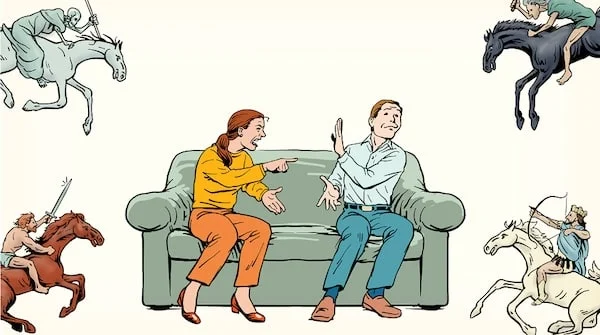
For more than four decades, the psychological community has looked to the University of Washington’s "Love Lab" as the gold standard for understanding interpersonal dynamics. Established by Dr. John Gottman and his colleagues, this longitudinal research facility utilized rigorous observational methods to decode the complexities of marital conflict. By monitoring couples’ physiological responses—including heart rate, skin conductance, and cortisol levels—while they engaged in high-stakes discussions, researchers were able to identify specific behavioral patterns that determine the longevity of a relationship. The most significant finding from this body of work is the identification of four distinct communication styles, famously termed the "Four Horsemen of the Apocalypse," which predict the end of a marriage with a 94% accuracy rate.
The research indicates that the subject matter of a couple’s disagreements—be it financial management, domestic responsibilities, or child-rearing—is largely irrelevant to the survival of the union. Instead, the methodology focuses on the "affect" or the emotional delivery and reception of messages during conflict. The presence or absence of these four behaviors serves as a diagnostic tool for the health of the relationship, offering a window into the eventual dissolution or stabilization of the partnership.
A Chronology of the Love Lab and Longitudinal Studies
The evolution of Gottman’s research began in the 1970s, when he first partnered with Robert Levenson to study the physiological correlates of marital interaction. In 1986, the "Love Lab" was formally established at the University of Washington. This facility was designed as a studio apartment where couples would spend a weekend while being recorded and monitored.
In 1992, Gottman published seminal data from a 14-year longitudinal study, which provided the first robust evidence for the 94% prediction rate. By the late 1990s and early 2000s, the research shifted from pure observation to intervention, leading to the development of the Gottman Method of Relationship Therapy. Throughout this timeline, the focus remained on the "Masters" and "Disasters" of relationships—those who stayed together happily and those who either separated or remained in chronically unhappy unions. The data gathered over these decades consistently pointed toward the same four destructive communication patterns.
The First Horseman: Criticism and Character Attacks
The first destructive behavior identified is criticism. While all relationships involve complaints, the research distinguishes between a healthy complaint and a destructive criticism. A complaint is a specific statement regarding a partner’s behavior or a particular incident. In contrast, a criticism is a global attack on the partner’s character or personality.
Data from the Love Lab shows that criticism often involves "globalizing" language, such as the use of "always" or "never." For instance, stating "I am upset that the dishes weren’t done" is a complaint. Stating "You never help around the house because you are selfish" is a criticism. The danger of criticism lies in its tendency to escalate. When a partner feels their character is under fire, they are less likely to address the original grievance and more likely to enter a state of self-defense.
The clinical antidote to criticism is the "Gentle Start-Up." Research suggests that the first three minutes of a conflict discussion are predictive of the outcome of the entire conversation. By using "I" statements and expressing a positive need rather than a negative judgment, couples can prevent the first horseman from entering the dialogue.
The Second Horseman: Contempt as a Predictor of Dissolution
Of the four behaviors, Gottman identifies contempt as the single greatest predictor of divorce. Contempt is defined as a state of moral superiority over one’s partner. It manifests through sarcasm, cynicism, name-calling, eye-rolling, and hostile mockery. Unlike criticism, which attacks character, contempt seeks to dehumanize and belittle the partner.
Physiological data from the Love Lab indicates that being the target of contempt has measurable health consequences. Partners in relationships characterized by high levels of contempt have been found to have higher rates of infectious illnesses, such as colds and the flu, due to the chronic stress suppressing their immune systems.
Contempt is often the result of long-standing resentments that have not been voiced or resolved. It creates a "negative filter" where the individual ignores the partner’s positive traits and focuses exclusively on their perceived flaws. The antidote to contempt is the intentional cultivation of a "culture of appreciation." By actively searching for things to admire in a partner and expressing gratitude regularly, couples can build a buffer against the erosion of respect.
The Third Horseman: Defensiveness and the Rejection of Responsibility
Defensiveness is a nearly universal response to criticism, yet it serves to escalate conflict rather than resolve it. It is characterized by the victimizing of oneself or the deflection of blame back onto the partner. Common forms of defensiveness identified in the research include "counter-complaining"—where one partner meets a grievance with a grievance of their own—and "yes-butting," where a partner appears to agree but immediately provides a justification that negates the agreement.
The psychological implication of defensiveness is the refusal to take responsibility for any part of the conflict. This behavior signals to the other partner that their concerns are invalid and that the speaker is not interested in collaboration. To counter defensiveness, Gottman recommends that individuals "accept influence" and take responsibility for even a small portion of the problem. Acknowledging one’s role in a disagreement acts as a "repair attempt," a crucial mechanism that de-escalates tension and allows the conversation to move toward a solution.
The Fourth Horseman: Stonewalling and Physiological Flooding
Stonewalling occurs when one partner withdraws from the interaction, shutting down verbally and emotionally. This may involve looking away, maintaining a "stony" silence, or physically leaving the room. While it may appear as though the stonewaller is indifferent, physiological data tells a different story.
In approximately 85% of cases, stonewallers are men. The Love Lab research found that this behavior is usually a reaction to "flooding," or Diffuse Physiological Arousal (DPA). When a person’s heart rate exceeds 100 beats per minute during a conflict, they enter a "fight or flight" state. In this condition, the prefrontal cortex—the part of the brain responsible for rational thought and problem-solving—is effectively bypassed. The individual becomes biologically incapable of processing information or communicating effectively.
The antidote for stonewalling is "physiological self-soothing." Partners are encouraged to call for a formal timeout, lasting at least 20 minutes, to allow their heart rates and cortisol levels to return to baseline. During this period, they must engage in activities that distract them from the argument, such as reading or exercise, rather than ruminating on the conflict.
Supporting Data: The 5:1 "Magic Ratio"
The presence of the Four Horsemen does not necessarily mean a relationship is doomed, provided there is a sufficient balance of positive interactions. One of the most famous metrics to emerge from the University of Washington is the 5:1 ratio. In stable, happy marriages, there are at least five positive interactions—such as a smile, a touch, or a word of affirmation—for every one negative interaction during a conflict.
In contrast, couples headed for divorce typically exhibit a ratio of 0.8:1. This data suggests that the "Masters" of relationships are not those who never fight, but those who maintain a "Relationship Bank Account" flush with positive sentiment. This emotional surplus allows the relationship to absorb the impact of occasional lapses into criticism or defensiveness without sustaining permanent damage.
Clinical Reactions and Professional Implications
The psychological community has largely embraced Gottman’s findings, leading to a paradigm shift in marital therapy. Prior to this research, many therapists focused on "active listening" techniques. However, Gottman’s data showed that active listening is rarely used by even the happiest couples during heated arguments because it is too difficult to execute under stress.
Instead, modern clinical practice emphasizes "emotional regulation" and "shared meaning." Statements from leading family therapists suggest that the ability to recognize the Four Horsemen in real-time is more effective than trying to follow a rigid script of communication. The research has also influenced workplace conflict resolution and leadership training, as the principles of avoiding contempt and taking responsibility are universal to all human cooperation.
Broader Impact and Future Outlook
The implications of the Four Horsemen extend beyond the private sphere of marriage. The ability to predict relationship stability has significant societal impacts, considering the correlation between marital health and general well-being, child development outcomes, and economic stability. By quantifying the "mechanics of love," the Gottman research has demystified romantic success, framing it as a set of learnable skills rather than a matter of chance or personality compatibility.
As the field of interpersonal neurobiology grows, future research is expected to further explore the neurological underpinnings of the Four Horsemen. However, the foundational work of the Love Lab remains a cornerstone of social science. It provides a clear, evidence-based roadmap for individuals seeking to navigate the complexities of long-term partnership by moving away from destructive patterns and toward a culture of mutual respect and physiological calm.

0 Comments