
Consumer behavior within the wearable technology sector is currently witnessing a nuanced shift as long-term smartwatch users increasingly reintegrate traditional analog timepieces into their daily rotations. While the Apple Watch has maintained a dominant market share since its 2015 debut, a growing demographic of professionals and enthusiasts are seeking "digital detox" opportunities, opting for the simplicity and aesthetic permanence of traditional horology. This trend is particularly evident in the entry-level segment, where watches priced under $100 are serving as low-risk entry points for consumers navigating the transition between high-tech wearables and classic accessories.
The Evolution of the Entry-Level Watch Market
The global watch market has undergone significant structural changes over the last decade. Following the "Quartz Crisis" of the 1970s and 1980s, which nearly decimated the Swiss mechanical watch industry, the market stabilized into distinct tiers: luxury mechanical, mid-range quartz, and budget-friendly utility. However, the introduction of the smartwatch disrupted the lower and mid-range tiers most aggressively. According to data from Strategy Analytics, Apple alone shipped more watches than the entire Swiss watch industry combined in 2019, a trend that has largely persisted.
Despite this digital saturation, the demand for traditional watches has not vanished; rather, it has evolved. Industry analysts suggest that the "always-on" nature of smartwatches has created a psychological fatigue among users. The intrusive nature of haptic notifications and the aesthetic uniformity of glass-and-aluminum rectangles have driven a resurgence in the appreciation for physical dials, ticking hands, and specialized designs. For many, the traditional watch is no longer a primary tool for timekeeping—given that smartphones provide atomic-clock accuracy—but has instead become a statement of personal style and a tool for intentional disconnection.
Chronology of the Wristwatch: From Utility to Tech and Back
To understand the current market positioning of sub-$100 watches, it is essential to examine the historical trajectory of the accessory:
- 1910s–1940s: The rise of the "trench watch" and field watch during World War I and II, establishing the wristwatch as a masculine tool of survival and synchronization.
- 1970s: The Quartz Revolution, led by Japanese manufacturers like Seiko and Citizen, makes accurate timekeeping affordable for the masses, ending the era of the mechanical watch as a necessity.
- 1980s–1990s: The emergence of the watch as a fashion accessory, popularized by brands like Swatch and Fossil.
- 2015: The launch of the Apple Watch, which redefined the "wrist real estate" as a hub for biometric data and communication.
- 2020–Present: The "Hybrid Lifestyle" era, where consumers balance the utility of smartwatches during fitness and work hours with the classic appeal of analog watches for social events and mental health "detox" periods.
Analyzing the Three Pillars of Budget Horology
For consumers looking to explore the traditional market without committing to the multi-thousand-dollar price tags of brands like Rolex or Omega, three distinct styles have emerged as the most viable entry points: the Field Watch, the Dress-Casual Hybrid, and the Minimalist Piece.
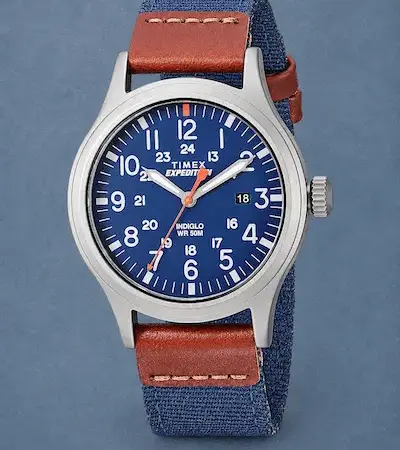
The Field Watch: The Timex Expedition Scout
The field watch remains a cornerstone of horology due to its rugged history and utilitarian design. The Timex Expedition Scout exemplifies this category. Originally designed for military personnel who required legibility in high-stress environments, the field watch features high-contrast numerals and a durable case.
Timex, an American heritage brand founded in 1854, has maintained its market relevance by perfecting the "value-to-performance" ratio. The Scout model utilizes a quartz movement, ensuring accuracy within seconds per month, and features the proprietary Indiglo night-light. Market data indicates that the Timex Expedition series remains one of the top-selling analog watches on platforms like Amazon, favored for its "no-nonsense" aesthetic that complements casual attire. The appeal lies in its perceived authenticity; it does not attempt to mimic a luxury item but instead embraces its identity as a reliable tool.
The Dress-Casual Hybrid: The Relic Rylan by Fossil Group
For those requiring a timepiece that bridges the gap between a professional environment and social settings, the Relic Rylan represents the "sub-brand" strategy employed by large conglomerates like the Fossil Group. Fossil has long utilized its manufacturing infrastructure to produce watches under various licenses and sub-brands, allowing them to capture different price segments of the market.
The Rylan model focuses on "substantiality"—using stainless steel construction and metal bracelets to provide a tactile weight that many consumers associate with quality. Unlike the field watch, which prioritizes legibility, the Rylan emphasizes "wrist presence." By incorporating design elements such as diamond accents and sunray dials, these watches offer a "luxury look" at a fraction of the cost. Analysts note that this segment is vital for younger professionals who may be entering the workforce and want to project a level of maturity that a rubber-strapped smartwatch may not convey in a formal boardroom setting.
The Minimalist Movement: The Skagen Signatur
The third major trend in the sub-$100 market is Nordic minimalism, championed by brands like Skagen (a subsidiary of Fossil since 2012). The Skagen Signatur reflects a design philosophy where "less is more." This style gained significant traction in the mid-2010s, coinciding with the rise of architectural and interior design trends favoring clean lines and neutral palettes.
Minimalist watches like the Signatur are characterized by slim profiles, often measuring less than 10mm in thickness. This allows the watch to sit comfortably under a shirt cuff, a practical advantage over the often-bulky sensors of a smartwatch. From a manufacturing standpoint, the minimalist design allows for the use of high-quality materials—such as leather straps and sandblasted dials—without the added cost of complex complications. This makes them a preferred choice for the "modernist" consumer who views a watch as a subtle extension of their wardrobe rather than a focal point.
Market Data and Consumer Sentiment
Recent surveys of watch enthusiasts and general consumers reveal a complex relationship with wearable technology. A 2023 industry report suggested that while 40% of adult consumers in the U.S. own a smartwatch, nearly 15% of those owners also purchased a traditional analog watch within the same 12-month period. This "dual-ownership" model suggests that the traditional watch is not being replaced, but rather repositioned.
Furthermore, the secondary market and "enthusiast" culture have seen a surge. Platforms like Reddit’s r/Watches (with over 2 million members) frequently highlight "budget icons" under $100. This community-driven validation has helped brands like Timex and Casio maintain a "cool factor" that transcends their low price points. Inferred statements from retail analysts suggest that the "compliment factor"—receiving positive feedback on a $50 Timex—often provides a higher level of psychological satisfaction to the wearer than the ubiquitous and expected presence of an Apple Watch.
The Broader Impact of Analog Re-adoption
The shift toward inexpensive traditional watches has broader implications for the jewelry and tech industries alike. For tech companies, it highlights a ceiling for "feature creep." There is a limit to how many sensors and notifications a human can comfortably manage before the simplicity of a non-connected device becomes a luxury in itself.
For the traditional watch industry, the success of the sub-$100 segment acts as a "gateway." A consumer who spends $60 on a Timex Expedition and enjoys the experience is significantly more likely to eventually "trade up" to a $500 Seiko or a $2,000 Tudor. This pipeline is essential for the long-term survival of the horological arts.
Moreover, the environmental impact of the "disposable tech" cycle is beginning to influence consumer choices. While a smartwatch has a functional lifespan of 3 to 5 years before the battery degrades or the software becomes obsolete, a simple quartz analog watch can last decades with minor battery changes. In an era of increasing environmental consciousness, the longevity of traditional watches—even inexpensive ones—presents a compelling counter-argument to the planned obsolescence of the Silicon Valley model.
Conclusion: Finding the Personal Fit
The decision to wear a traditional watch in the age of the smartphone is rarely about the necessity of knowing the time. It is an exercise in intentionality. Whether it is the rugged utility of a field watch, the polished presence of a stainless-steel dress watch, or the quiet elegance of a minimalist design, these timepieces offer a reprieve from the digital noise of the 21st century.
As the market continues to bifurcate between "high-tech utility" and "classic style," the sub-$100 category remains a vital proving ground. It allows consumers to experiment with their personal style, rediscover the tactile joy of a physical dial, and determine whether they truly need to be "connected" every second of the day. In the end, a watch that costs less than a pair of high-end sneakers may provide the most valuable commodity of all: the ability to look at one’s wrist and see nothing but the time.

0 Comments