
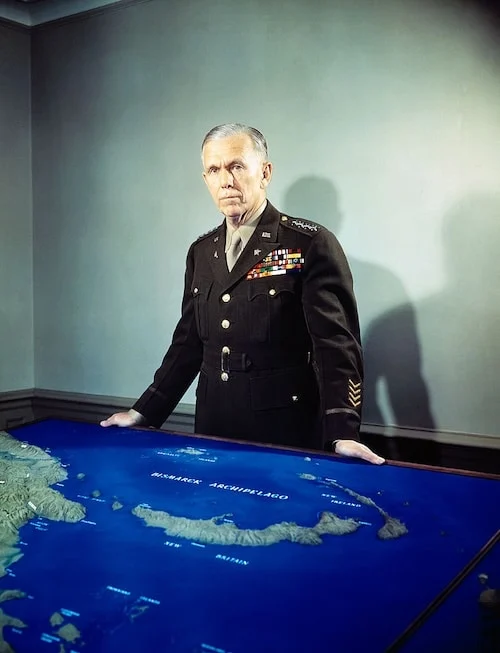
The challenges of the modern high-responsibility workplace, characterized by the "always-on" culture of digital communication and the blurring of professional and personal boundaries, find a historical parallel in the administrative crisis faced by General George C. Marshall during the early 1940s. As the Chief of Staff of the United States Army from 1939 to 1945, Marshall was tasked with an organizational expansion of unprecedented scale, transforming a neglected military force into a global superpower while maintaining a rigid personal discipline that prioritized mental clarity over sheer hours logged. His methodology, which combined radical bureaucratic restructuring with a refusal to succumb to the "urgency trap," remains a foundational case study in executive efficiency and strategic leadership.
Historical Context: The Pre-War Administrative Crisis
When George Marshall assumed the role of Chief of Staff on September 1, 1939—the same day Nazi Germany invaded Poland—the United States Army was ill-prepared for large-scale conflict. Ranked 17th in the world in terms of size and readiness, the Army consisted of approximately 190,000 personnel. By the end of the war in 1945, Marshall had overseen its growth to a peak of 8.3 million soldiers.
The administrative structure Marshall inherited was a relic of the post-World War I era, designed for a small, static force rather than a global expeditionary power. The War Department was a labyrinth of competing interests. Over 60 different bureaus, agencies, and division heads reported directly to the Chief of Staff. This meant that Marshall’s daily schedule was consumed by minor jurisdictional disputes, procurement details, and personnel grievances. Historians note that in the early years of his tenure, Marshall frequently described himself as being "worked to tatters," struggling to find the time necessary for high-level strategic planning because he was constantly mired in the minutiae of a bloated bureaucracy.
Chronology of Reform and the 1942 Reorganization
The evolution of Marshall’s management style was punctuated by several key milestones that allowed him to transition from a micro-manager by necessity to a strategic leader by design:
- September 1939: Marshall is sworn in as Chief of Staff. He immediately begins lobbying Congress for increased funding and the implementation of the first peacetime draft in U.S. history.
- 1940–1941: The "GHQ" (General Headquarters) experiment. Marshall attempts to delegate operational control to a separate headquarters, but the lines of authority remain blurred, leading to further administrative confusion.
- December 7, 1941: The attack on Pearl Harbor. The entry of the United States into World War II necessitates an immediate and total overhaul of the War Department to manage a multi-front global war.
- March 9, 1942: Implementation of Executive Order 9082 and War Department Circular 59. This marked the most radical reorganization in the history of the U.S. Army, effectively "blowing up" the existing bureaucracy.
- 1942–1945: The "Marshall System" in full effect. Marshall maintains a strict 5:00 PM departure and a disciplined personal routine while directing the Allied efforts in nine theaters of war.
Structural Overhaul: The Three-Pillar System
The cornerstone of Marshall’s ability to reclaim his time was the 1942 reorganization, spearheaded by Brigadier General Joseph T. McNarney under Marshall’s direction. The goal was to reduce the number of direct reports and create autonomous commands that could handle specialized functions without constant oversight.
Marshall collapsed dozens of independent agencies into three major commands:
- Army Ground Forces (AGF): Responsible for the training and organization of combat troops.
- Army Air Forces (AAF): Given near-autonomy to manage the rapidly expanding aerial warfare requirements.
- Services of Supply (later Army Service Forces): Tasked with the massive logistical undertaking of procurement and distribution.
By delegating these functions, Marshall reduced his direct reports from over 60 to roughly six key subordinates. This structural change shifted the Chief of Staff’s role from a mediator of departmental squabbles to a pure strategist.
The Operations Division: The Brain of the War Department
To manage the flow of information from global battlefields, Marshall established the Operations Division (OPD). Functioning as his "command post," the OPD served as a sophisticated information filter. Every message from theater commanders like Dwight D. Eisenhower or Douglas MacArthur was routed through the OPD.
Staff officers within the OPD were tasked with synthesizing thousands of pages of intelligence into concise summaries. Marshall’s standing order was that the OPD should only bring him the "broad phases of plans" or critical changes in the strategic landscape. This ensured that when Marshall arrived at his desk each morning, the "noise" of the war had been filtered out, leaving only the "signals" that required his specific executive judgment.
Supporting this was Marshall’s famous "one-page memo" rule. He demanded that any problem, no matter how complex—including the development of the atomic bomb or the logistics of the D-Day invasion—be presented with a proposed solution on a single sheet of paper. This forced his staff to perform the "heavy lifting" of critical thinking before engaging the Chief of Staff’s time.
The Psychological Strategy of Deliberate Rest
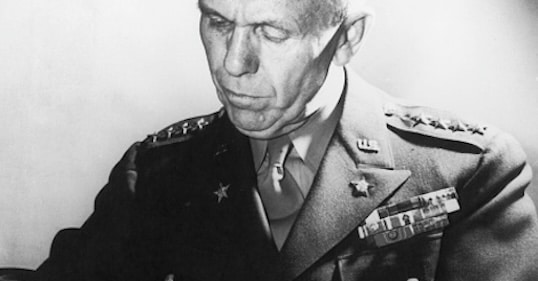
Perhaps the most unconventional aspect of Marshall’s leadership was his commitment to personal recovery. Despite the existential stakes of the war, Marshall maintained a schedule that modern observers might find remarkably "low-intensity."
His daily routine was characterized by a rigid adherence to boundaries:
- 06:30 AM: Wake up and breakfast.
- 07:30 AM: Arrival at the War Department.
- 08:00 AM: Global briefing and high-level strategic work.
- Midday: A lunch followed by a mandatory power nap—a habit he also urged his field commanders to adopt to maintain cognitive function.
- 05:00 PM: Immediate departure from the office.
Marshall’s evening routine was designed for total mental detachment. He engaged in horseback riding at Fort Myer, often accompanied only by his dog or his stepdaughter. He strictly prohibited his colleagues from joining him during these rides, specifically to prevent "office talk" from intruding on his recovery time. He was typically in bed by 9:00 PM, ensuring eight hours of sleep.
This was not an act of leisure, but a calculated strategy for sustainability. Marshall understood that "decision fatigue"—a phenomenon now well-documented by modern psychology—was a greater threat to the war effort than any single tactical error. By maintaining his physical and emotional reserves, he remained "cheerful and optimistic" even during the darkest days following Pearl Harbor and the fall of the Philippines.
Data and Analysis: The Impact of Executive Efficiency
The effectiveness of Marshall’s time-management and delegation strategy is reflected in the sheer volume of activity the War Department handled under his tenure. Between 1941 and 1945, the U.S. Army’s budget grew from approximately $9 billion to over $50 billion annually. The complexity of the Manhattan Project alone represented one of the largest industrial and scientific undertakings in human history, yet it was managed as just one of many "urgent" priorities on Marshall’s plate.
Analysis by military historians suggests that Marshall’s ability to remain detached from the daily "grind" allowed him to see the war in its entirety. While other leaders became obsessed with specific battles, Marshall focused on the global "inter-theater" logistics, balancing the needs of the Pacific against the priority of the European theater.
His refusal to work late hours also set a cultural tone for the War Department. It signaled that efficiency was valued over "performative busyness." By empowering his subordinates to make decisions, he built a deep bench of leadership that included future presidents and five-star generals.
Legacy and Modern Implications
General George Marshall’s approach to work-life boundaries offers a stark contrast to the modern "hustle culture." His career culminated not only in military victory but in the creation of the Marshall Plan for the reconstruction of Europe and the receipt of the Nobel Peace Prize in 1953.
The "Marshall Plan" for personal productivity suggests that high-stakes success is not a product of infinite hours, but of rigorous prioritization, aggressive delegation, and the protection of one’s cognitive capacity. In an era where digital tools have made it possible to work 24 hours a day, Marshall’s example serves as a reminder that the quality of executive judgment is often inversely proportional to the exhaustion of the executive.
Ultimately, Marshall’s legacy demonstrates that even when the fate of democracy is at stake, the most effective tool a leader possesses is a rested and focused mind. His ability to walk away from his desk at 5:00 PM was not a sign of indifference, but a supreme act of discipline that ensured he was ready to face the world again at 7:30 AM.

0 Comments