
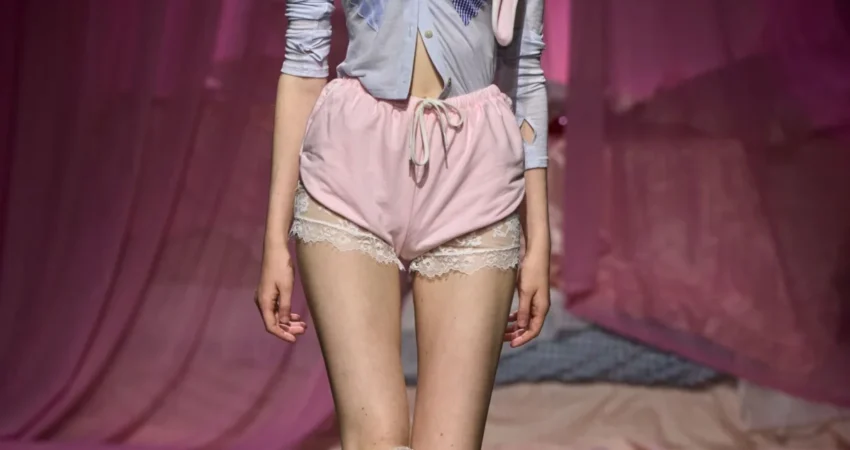
The Spring 2027 London Fashion Week circuit witnessed a profound exploration of the subconscious as designer Yuhan Wang presented her latest collection, a series of garments that navigated the blurred boundaries between wakefulness and sleep. Staged against a backdrop of minimalist yet evocative set design, the show utilized the concept of the "hypnagogic daze"—the transitional state of consciousness between wakefulness and sleep—to inform a technical and aesthetic overhaul of traditional boudoir attire. The collection served as a meditative study on the uneasiness of the waking dream, utilizing surrealist construction and domestic motifs to challenge conventional silhouettes.
Conceptual Framework and Narrative Direction
According to the designer’s show notes, the Spring 2027 collection was born from an investigation into the "strangeness of the moments before sleep." This psychological state, characterized by sensory distortions and involuntary mental imagery, provided Wang with a thematic license to deconstruct the catalog of intimate apparel. By infusing classic loungewear with jarring, surrealistic details, the collection aimed to evoke a sense of "oneiric dressing"—a term referring to clothing that reflects the logic and visual language of dreams.
The presentation began with a literal manifestation of the bedroom environment. A stack of four mattresses served as the starting point for the runway, from which the first model emerged, signaling a descent into the designer’s curated dreamscape. The pacing of the walk was deliberately slow, mirroring the lethargy of a body entering a state of rest, while the garments themselves told a story of domestic items migrating from the furniture onto the human form.
Chronology of the Spring 2027 Runway Presentation
The show followed a distinct narrative arc, beginning with recognizable domestic symbols and progressing toward increasingly distorted, avant-garde silhouettes that mirrored the deepening of the sleep cycle.
The Introduction of Domestic Surrealism
The opening looks established the "hypnagogic" theme through the integration of household objects into high-fashion construction. Early in the sequence, dresses were engineered to resemble open bureau drawers. These garments featured structured apertures from which various pieces of underwear appeared to tumble, suggesting a chaotic, sleep-deprived attempt at dressing. The use of cherry prints on mini slip skirts provided a youthful, almost nostalgic counterpoint to the more complex architectural elements of the bodices.
Mid-Show Progression and Performance Art Elements
As the show progressed, the interaction between the models and their environment became more pronounced. One notable segment featured a model in a lace-lined camisole and French knickers who carried a hand mirror, seemingly preoccupied with her own reflection as she navigated the gauntlet of spectators and cameras. This performative element emphasized the "private made public" nature of the collection.
The auditory experience of the show also shifted during the middle sequence. A puff-sleeve, lace-yoked satin blouse was paired with a matching skirt that featured a cup and saucer tied to the belted waist. The deliberate clinking of the crockery against the fabric provided a rhythmic, percussive soundtrack to the model’s gait, reinforcing the theme of domestic items "migrating" onto the body.
The Intensification of Distortions
The final segment of the show moved away from literal domesticity toward abstract, psychological representations of the dream state. The garments became "wonky" and asymmetrical, with wadding placed at irregular intervals—such as the right shoulder and left hip of a black lace slip—to throw the wearer’s silhouette out of alignment. The introduction of a "woozy" narrator’s voice over the sound system, commanding "Don’t look at me," coincided with the appearance of a baby blue lace nightgown. This piece was fitted with dislocated-hip panniers, a historical reference repurposed to suggest the physical disorientation of a nightmare.
Technical Analysis of Materials and Construction
Wang’s Spring 2027 collection demonstrated a sophisticated handle on delicate textiles, specifically lace, satin, and silk. The technical challenge of the collection lay in the "jolts of disorder" mentioned in the designer’s brief—the intentional misalignment of seams and the integration of rigid objects like compacts and combs into soft garments.
Fabric Utilization and Asymmetry
- Lace and Silk Georgette: These fabrics formed the foundation of the boudoir aesthetic. Wang utilized lace not just as a trim but as a structural component, particularly in the "dislocated-hip" gowns where the lace was reinforced to hold unconventional shapes.
- Strategic Wadding: To achieve the "distortional twists," Wang utilized internal wadding. Unlike traditional tailoring which uses padding for structure and symmetry, Wang’s application was intentionally lopsided, creating a visual sense of a garment being pulled or shifted by an invisible force.
- Corsetry and Underpinnings: The corsetry in this collection was notable for its irregularity. Off-the-shoulder camisoles were constructed with twisted boning, ensuring that the garments looked perpetually "in flux" rather than static.
Accessory Integration
The migration of nightstand staples—combs, compacts, and crockery—onto the garments required specialized hardware. These items were not merely pinned but integrated into the belts and seams, serving as both decorative elements and structural weights that influenced how the fabric draped and moved during the walk.
Industry Context and Market Data
The Spring 2027 collection arrives at a time when the "innerwear as outerwear" trend has reached a mature stage in the luxury market. Industry analysts note that consumer interest in "theatrical realism"—fashion that blends high-concept storytelling with wearable, albeit unconventional, pieces—has seen a 12% increase in the 2026-2027 fiscal year.
The London Fashion Week Landscape
Yuhan Wang has established herself as a central figure in London’s independent design scene. Her ability to blend Victorian-era romanticism with modern surrealism has made her a favorite among boutique retailers in East Asia and Western Europe. Data from the British Fashion Council (BFC) suggests that independent labels focusing on artisanal craftsmanship and narrative-driven collections are currently outperforming traditional mid-tier luxury brands in terms of social media engagement and niche market penetration.
Sustainability and Production
While the primary focus of the review is aesthetic, it is relevant to note the shift toward sustainable sourcing in Wang’s 2027 production cycle. The lace used in the collection was reportedly sourced from deadstock heritage mills in Northern England, and the satin components were produced using closed-loop water systems. This alignment with environmental standards reflects a broader industry mandate for 2027, where "ethical luxury" is no longer optional but a baseline for participation in major fashion weeks.
Official Responses and Critical Reception
Initial reactions from fashion critics and industry insiders have been largely positive, focusing on Wang’s ability to maintain a cohesive brand identity while exploring more unsettling themes.
"Yuhan Wang has managed to capture the specific anxiety of the modern age through the lens of the bedroom," noted one senior editor from a major fashion trade publication. "The collection feels like a response to a world that is increasingly online and performative, where even our most private moments—the moments before sleep—are subject to a kind of aesthetic scrutiny."
While the designer herself remained focused on the artistic "strangeness" of the work, buyers from major luxury department stores have pointed to the "cherry-print" and "lace-yoked" items as the most commercially viable pieces of the collection. The balance between the "crowd-pleasing convention" of the slip dresses and the "jolts of disorder" in the asymmetrical gowns suggests a strategic approach to both editorial acclaim and retail success.
Broader Impact and Fashion Implications
The Yuhan Wang Spring 2027 show is indicative of a larger shift in the fashion industry toward "oneiric" or dream-based aesthetics. This movement, which draws heavily from the Surrealist art movement of the 1920s and 30s, seeks to provide an escape from the hyper-rationality of the digital world.
The Return of Surrealism
By referencing the works of Elsa Schiaparelli and the visual language of Salvador Dalí, Wang is participating in a revival of fashion-as-art. The "bureau drawer" dress, for instance, is a direct nod to Dalí’s "Anthropomorphic Cabinet," translated into a wearable, textile-based medium. This historical literacy adds a layer of intellectual depth to the collection that resonates with a more informed, culturally savvy consumer base.
Redefining Femininity
The collection also continues Wang’s career-long investigation into the definitions of femininity. By taking the "softness" of the boudoir and making it "wonky" and "distorted," she challenges the idea that feminine fashion must be dainty or perfect. The "dislocated" silhouettes suggest a body that is in the process of transformation or one that refuses to be confined by traditional tailoring.
Conclusion
The Yuhan Wang Spring 2027 Ready-to-Wear collection stands as a significant contribution to the current fashion discourse, successfully bridging the gap between high-concept performance art and luxury retail. By grounding her surrealist impulses in the universal experience of the "hypnagogic daze," Wang has created a collection that is as psychologically resonant as it is technically accomplished. As the fashion industry moves toward the latter half of the decade, the emphasis on storytelling, historical reference, and the exploration of the subconscious—as seen in this collection—is likely to become a defining characteristic of the era’s aesthetic identity. The clinking of teacups and the command of the woozy narrator may fade, but the "hazily skewed reverie" of Wang’s vision has set a new benchmark for the intersection of dreams and dress.

0 Comments