
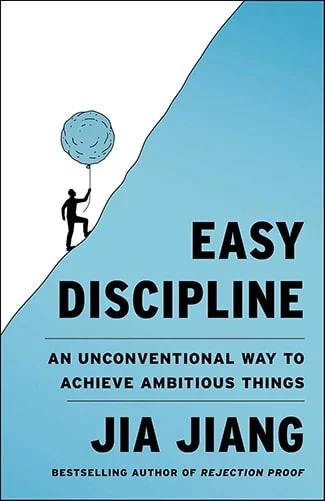
The central thesis presented by Jiang suggests that the most successful individuals do not necessarily possess a superhuman capacity for willpower; rather, they have mastered the art of making the "right" actions the "easiest" actions to perform. This perspective moves away from the concept of "hard discipline"—characterized by white-knuckling through tasks—and toward "easy discipline," where consistency is born from enjoyment and identity alignment.
The Evolution of Discipline: From Rejection to Flow
The background of Jia Jiang provides a critical context for this shift in philosophy. Jiang first gained international prominence through his "100 Days of Rejection" project, an experiment in which he intentionally sought out rejection in various social and professional scenarios to desensitize himself to the pain of "no." While that project focused on building resilience through exposure, his subsequent work has pivoted toward the mechanics of long-term sustainability.
Jiang’s transition into the study of discipline began with a realization: while grit can help someone survive a temporary crisis, it is a poor fuel for a lifetime of work. He argues that the traditional Chinese concept of "eating bitterness" (chi ku)—the idea that one must endure hardship to achieve greatness—is culturally ingrained but psychologically inefficient.
The Theoretical Framework: Hard vs. Easy Discipline
To understand the implications of Jiang’s work, one must distinguish between the two primary modes of discipline discussed in the podcast.
Hard Discipline is defined as the reliance on sheer willpower to overcome resistance. It is often fueled by extrinsic motivators, such as the fear of failure or the desire for status. Behavioral science suggests that this model is prone to "ego depletion," a theory popularized by psychologist Roy Baumeister, which posits that willpower is a finite resource that can be exhausted. While the scientific community continues to debate the exact nature of ego depletion, the practical experience of "burnout" remains a significant obstacle for those relying solely on hard discipline.
Easy Discipline, by contrast, is the process of designing one’s work and life so that the desired behavior becomes the path of least resistance. This involves:
- Identity Alignment: Pursuing goals that are an expression of who the individual is, rather than who they think they should be.
- Gamification and Play: Incorporating elements of play into serious work to trigger dopamine responses that encourage repetition.
- Environmental Design: Altering one’s physical and digital surroundings to remove triggers for bad habits and highlight triggers for good ones.
Historical and Cultural Case Studies
The podcast highlights several historical examples to illustrate how high-performance systems often favor "easy" flow over "hard" friction.
The Soviet Hockey System
In the 20th century, the Soviet Union’s national hockey team revolutionized the sport not through brute force, but through a system of "total hockey." While North American teams focused on individual toughness and "hard" discipline (aggressive checking and physical intimidation), the Soviets focused on intricate passing, fluid movement, and collective intelligence. Their training was rigorous, but it was designed to make the game feel like a choreographed dance—a form of play. By making the sport about creativity and flow, they achieved a level of dominance that relied on systemic "easiness" rather than individual "hardness."
The Japanese Tea Ceremony
The Japanese Chanoyu (tea ceremony) serves as a metaphor for the ritualization of discipline. The ceremony transforms a mundane task—making tea—into a highly disciplined, meditative art form. The discipline required is not "hard" in the sense of being painful; it is "easy" because it is governed by a deep sense of presence and aesthetic appreciation. This demonstrates how structure and ritual can make discipline feel like a rewarding experience rather than a chore.
The "One-Action Goal" Strategy
A practical application discussed by Jiang is the "One-Action Goal." Traditional goal-setting often focuses on massive, long-term outcomes (e.g., "lose 50 pounds" or "write a 400-page novel"). These goals are often intimidating and lead to procrastination.
The One-Action Goal simplifies the objective to the smallest possible point of entry. For a writer, the goal is not to write a chapter, but to open the laptop. For a runner, the goal is to put on their shoes. By focusing on a single, effortless action, the individual bypasses the brain’s "amygdala hijack"—the fear response that occurs when a task feels too difficult. Once the first action is taken, the momentum of "easy discipline" usually carries the person through the rest of the task.

Supporting Data and Behavioral Science Context
The move toward "easy discipline" is supported by various studies in the field of behavioral economics and habit psychology. Research conducted by Dr. Wendy Wood, a leading expert on habits at the University of Southern California, suggests that approximately 43% of daily behaviors are performed out of habit rather than conscious decision-making.
Wood’s research indicates that people who are perceived to have "high self-control" actually spend less time resisting temptation. Instead, they structure their lives to avoid temptation altogether. This data aligns with Jiang’s assertion that the most disciplined people are those who have made their discipline "easy" through environmental management.
Furthermore, the concept of "Implementation Intentions," developed by psychologist Peter Gollwitzer, shows that individuals who create "if-then" plans (e.g., "If it is 8:00 AM, then I will sit at my desk") are significantly more likely to follow through on their goals. These plans reduce the cognitive load required to start a task, shifting the burden from the prefrontal cortex (the seat of willpower) to the basal ganglia (the seat of habit).
Official Responses and Expert Analysis
The principles discussed in The Art of Easy Discipline reflect a broader trend in the self-improvement and corporate productivity sectors. Experts in organizational behavior have noted that "hustle culture"—which prioritizes long hours and "grinding"—is increasingly being replaced by models of "sustainable high performance."

Dr. Cal Newport, author of Deep Work and Slow Productivity, has argued for similar shifts, suggesting that the volume of work is less important than the quality and sustainability of the effort. The reaction from the professional community suggests that Jiang’s "Easy Discipline" is part of a necessary correction to the high rates of occupational burnout seen in the 21st-century workforce.
Broader Impact and Implications
The shift from hard to easy discipline has significant implications for education, healthcare, and management.
In Education: If discipline can be made "easy" through play and interest, the traditional model of rote memorization and "hard" testing may be less effective than project-based learning that aligns with a student’s natural curiosities.
In Healthcare: Patient compliance with long-term medication or exercise regimens is notoriously low. By applying "easy discipline" techniques—such as habit stacking or environmental nudges—healthcare providers may see higher rates of adherence to treatment plans.

In the Workplace: Managers who foster an environment of "psychological safety" and "flow" rather than one of high-pressure surveillance may find that their employees are more consistent and productive. When work is designed to be engaging rather than punitive, the need for management-enforced discipline decreases.
Conclusion: Redefining the Path to Excellence
Podcast #1125: The Art of Easy Discipline serves as a manifesto for a more humane and effective approach to personal growth. Jia Jiang’s insights suggest that the barrier to success is not a lack of pain, but a lack of design. By understanding the mechanics of the human brain and the power of environment, individuals can move away from the cycle of effort and exhaustion.
The ultimate takeaway is that discipline is not a badge of suffering to be worn, but a tool to be optimized. When the path to a goal is made enjoyable and the friction of starting is removed, "discipline" ceases to be a struggle and becomes a natural expression of an individual’s intent. As Jiang concludes, the most sustainable way to achieve extraordinary results is to stop trying to be a martyr and start trying to be an architect of one’s own habits.

0 Comments