
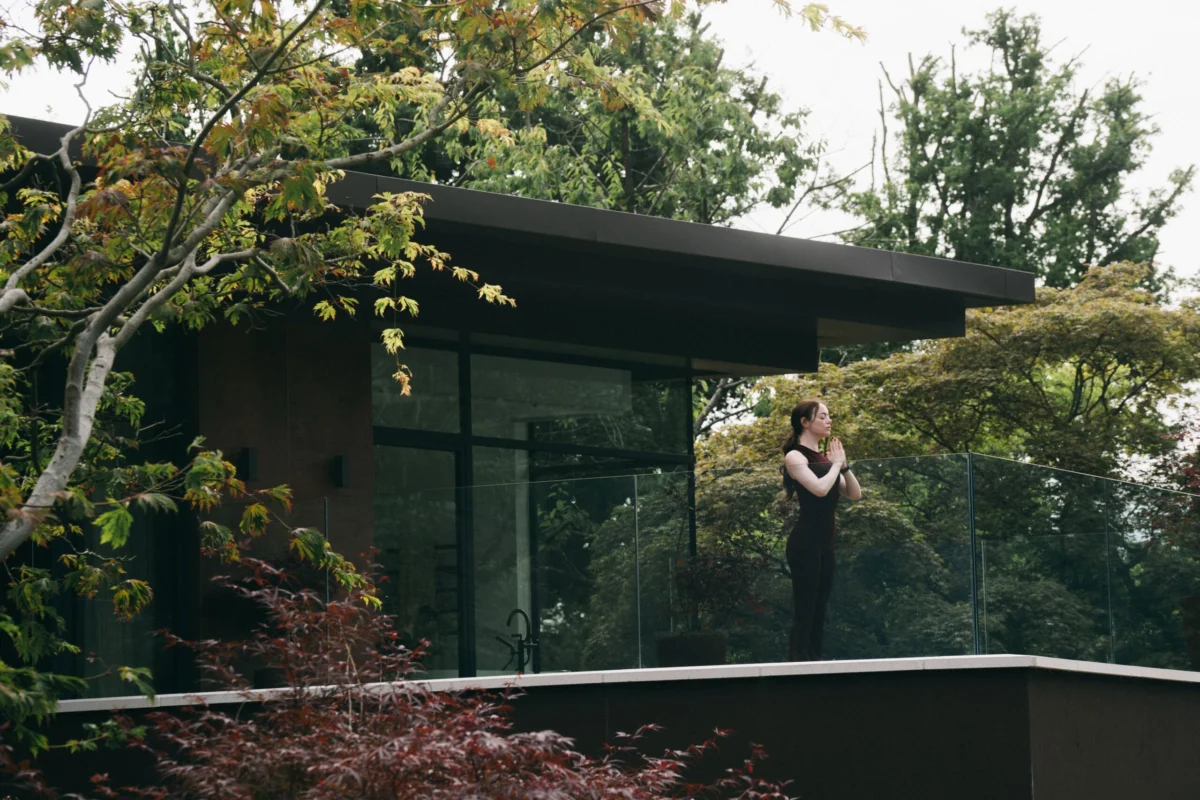
The visual landscape of Yorgos Lanthimos’s latest cinematic offering, Bugonia, released in 2025, is a meticulously curated testament to human ingenuity, paradoxically serving as a chilling harbinger of humanity’s impending doom. From the sleek, corporate interiors to the avant-garde residential spaces, the film is populated by design icons that speak volumes about its enigmatic protagonist, Michelle Fuller, played by a commanding Emma Stone. Production designer James Price, in collaboration with director Lanthimos, has woven a narrative tapestry where the very objects meant to signify human achievement become subtle, unsettling indicators of an alien presence.
Early scenes immediately immerse the viewer in a world of refined aesthetics. As Michelle Fuller, the CEO of Bugonia, makes her purposeful stride towards her office, the camera lingers on a striking arrangement of Ludwig Mies van der Rohe’s Barcelona chairs. These iconic pieces, with their distinctive cantilevered steel frames and plush, boxy leather cushions, exude a late mid-century corporate grandeur. Their initial appearance in black, transitioning to white as Michelle approaches her glass-enclosed sanctuary, is an intentional visual cue, hinting at the duality and perhaps the evolving nature of her identity. This deliberate use of such recognizable design elements extends throughout Michelle’s environment, encompassing her ultra-modernist home and professional spaces, featuring works by luminaries such as Frank Lloyd Wright, Jan Bocan, and others.

The profound implication of these design choices becomes starkly apparent by the film’s conclusion. In a revelation that recontextualizes every meticulously placed object, Michelle is revealed to be the extraterrestrial entity responsible for mankind’s extinction. This narrative twist prompts a deeper analysis of Lanthimos and Price’s artistic intent: were they deliberately playing with the concept of vaunted human achievement versus embodied humanity through the film’s sets? The suggestion is that this masked extraterrestrial infiltrator utilizes an encyclopedic knowledge of human design not merely as a façade, but as a form of proof of her perceived authenticity. However, the objects she surrounds herself with, while embodying pinnacle human creativity, possess a disquieting coolness and an almost sterile immaculateness. Their imposing stature and precise presentation, far from humanizing her, serve as subtle, yet powerful, hints that Michelle might be engaging in a form of overcompensation, attempting to project an ideal of humanity that ultimately underscores her otherness.
"I would almost liken the pieces we included to trophies," Price shared in an exclusive interview with Architectural Digest. "You could take these examples as pinnacles of human civilization. So much so that Yorgos wasn’t keen on us even having reproductions." This statement underscores the film’s deliberate choice to employ authentic or meticulously recreated iconic pieces, emphasizing their status as the zenith of human artistic and engineering prowess. Michelle, therefore, appears to have meticulously collected these items as a kind of physical highlight reel of human creativity. In doing so, she seeks subtle self-validation of her humanity, paradoxically using these very symbols of human achievement to mask her true nature. Yet, the inherent irony lies in the fact that once possessed, these celebrated objects, particularly when curated for such a specific purpose, can become static and even cold. In her attempt to project an idealized human persona, Michelle inadvertently injects a chilling reserve into her surroundings, a subtle but pervasive sense of inhumanity. This is not a critique of the design pieces themselves, but rather an observation of how their presentation within the film amplifies the character’s exaggerated performance of humanity.
The Midcentury Modernist Echo: Sci-Fi Inspirations and a Future Past
While Bugonia is set in the contemporary year of 2025, Price’s design direction drew heavily from the visual lexicon of mid-century science fiction classics. This era, marked by rapid technological advancement and a fascination with space exploration, provided a rich source of inspiration. Films such as Stanley Kubrick’s 1968 masterpiece, 2001: A Space Odyssey, with its iconic Djinn chairs and Saarinen tables, and the 1965 British spy thriller The Ipcress File, known for its minimalist yet impactful set design, significantly influenced the film’s aesthetic. The latter, in particular, provided a framework for some of the more stark and controlled environments, mirroring the film’s exploration of inverted villainy, a theme that remains in constant flux within Bugonia‘s narrative.

"I did want to play around with the fact that there was a sort of quintessential mid-century aesthetic idea of what space travel would look like," Price elaborated. "The Space Race, which lasted from 1955 to 1975, and the advancing technology of the time… it all does go hand in hand." This sentiment reflects a broader cultural moment where the future was envisioned through the lens of emerging technologies and a fascination with the cosmos, often rendered with a sleek, modernist sensibility. The film’s design choices thus tap into this historical zeitgeist, creating a future that feels both familiar and eerily alien.
A Curated Collection: Iconic Furniture as Character Development
The film’s deliberate placement of renowned design pieces serves as a powerful tool for character development, offering visual clues to Michelle Fuller’s complex and ultimately alien identity.
Barcelona Chairs by Ludwig Mies van der Rohe (1929/1950)
The Barcelona Chair, a collaboration between Ludwig Mies van der Rohe and Lilly Reich, was initially conceived for the German Pavilion at the 1929 International Exposition in Barcelona. Its enduring legacy was cemented with a redesign in 1950, which introduced the seamless, cantilevered base that remains its hallmark. Mies van der Rohe himself described the chair as intended to be "important" and "monumental," qualities that resonate with Michelle’s ambitious and imposing presence. The subtle shift in their color from black to white as Michelle approaches her office suggests a transformation or a revealing of a different facet of her persona, aligning with the growing suspicion of her true nature. These chairs, symbolizing the pinnacle of modern design and human refinement, become an ironic counterpoint to the alien entity occupying them.

Taliesin 2 Floor Lamp by Frank Lloyd Wright (1952)
Frank Lloyd Wright’s Taliesin 2 Floor Lamp, designed in 1952, possesses a striking, almost anthropomorphic quality. Its tall, geometric form and the rectangular "boxes" of light attached to an overhead beam evoke a sense of posture and presence, akin to a stoic figure. Wright’s inspiration for this lamp reportedly stemmed from a task to repair a theater damaged by fire, where he ingeniously adapted rectangular light fixtures. The soft glow he achieved led him to create a floor lamp version for his own iconic home, Taliesin. In Bugonia, this lamp, with its subtly human-like silhouette, stands as another testament to human creative expression, yet its imposing presence within Michelle’s sterile environments adds to the overall sense of an alien attempting to mimic or dominate human aesthetics.
Ribbon Lamp by Claire Norcross (2005)
Manchester-based designer Claire Norcross’s Ribbon Lamp, created in 2005 for Habitat, also contributes to the film’s unsettling atmosphere. The lamp’s distinctive flowing band, its angular feet, and its overall form possess an "oddly bodily" and "alien seeming" quality, as noted by the film’s designers. Positioned on Michelle’s desk, this piece, while modern and artistic, carries a visual suggestion of organic strangeness, further blurring the lines between human and extraterrestrial design appreciation.
Jan Bocan Armchairs
A pair of Jan Bocan’s armchairs are strategically placed beside Michelle’s high-gloss, glass-enclosed home pool. Bocan’s work, characterized by its brutalist yet curvilinear aesthetic, is highly collectible. The specific chairs featured in Bugonia are noted to have been designed for the former Czechoslovak Embassy in London, a building Bocan designed and which was completed in 1970. These chairs, representing a significant moment in modernist architectural and interior design history, are juxtaposed against the seemingly serene, yet ultimately isolated, environment of Michelle’s opulent residence, hinting at a hidden complexity and perhaps a past rooted in significant, yet controlled, human endeavors.

Imola Chair by Henrik Pederson (Designed for BoConcept)
Henrik Pederson’s Imola Chair, designed for the Danish label BoConcept, serves as a direct nod to Michelle’s underlying menace. Its design, featuring a winged headrest that evokes a sense of campy wickedness, makes it an ideal choice for what Price jokingly refers to as Michelle’s "evil lair." The film shows Michelle at home, wearing an infrared mask while seated in this chair, a visual that strongly suggests a clandestine operation or a preparation for something sinister. The Imola Chair’s association with villainy is further amplified by a notable historical precedent: a similar wingbacked chair was famously occupied by James Bond villain Ernst Stavro Blofeld, played by Donald Pleasence, in the 1967 film You Only Live Twice. This cinematic lineage, connecting to the work of The Ipcress File‘s production designer Sir Ken Adam, reinforces the film’s exploration of deceptive power and hidden threats.
The Broader Implications: Design as a Mirror to Identity and Extinction
The strategic deployment of iconic design in Bugonia transcends mere set dressing; it is integral to the film’s thematic core. By saturating Michelle’s world with objects that represent the pinnacle of human creative and intellectual achievement, the filmmakers pose a profound question: can the outward manifestation of culture truly signify inner humanity, or can it be a sophisticated imitation? The film suggests the latter, implying that Michelle’s curated environment is a meticulously constructed performance, a desperate attempt to blend in or perhaps even to understand the species she is systematically eradicating.
The choice of mid-century design, with its optimistic futurism and often stark, geometric forms, also serves as a poignant commentary on the trajectory of human ambition. This era, which looked towards the stars with boundless curiosity, is now framed as the very period whose cultural artifacts would be preserved by an alien intelligence as a final testament to a lost civilization. The film’s narrative arc, therefore, becomes a cautionary tale, not just about the fragility of humanity, but also about the complex relationship between creation, identity, and legacy. The ultimate message embedded within the pristine lines of a Barcelona chair or the elegant silhouette of a Frank Lloyd Wright lamp is that even the most celebrated achievements of human civilization can, in the face of overwhelming external forces, become mere relics of a vanished era. The film leaves audiences pondering whether our most cherished expressions of culture are, in the end, sufficient to define our essence, or if they can be so convincingly replicated that their original meaning is irrevocably lost.

0 Comments