
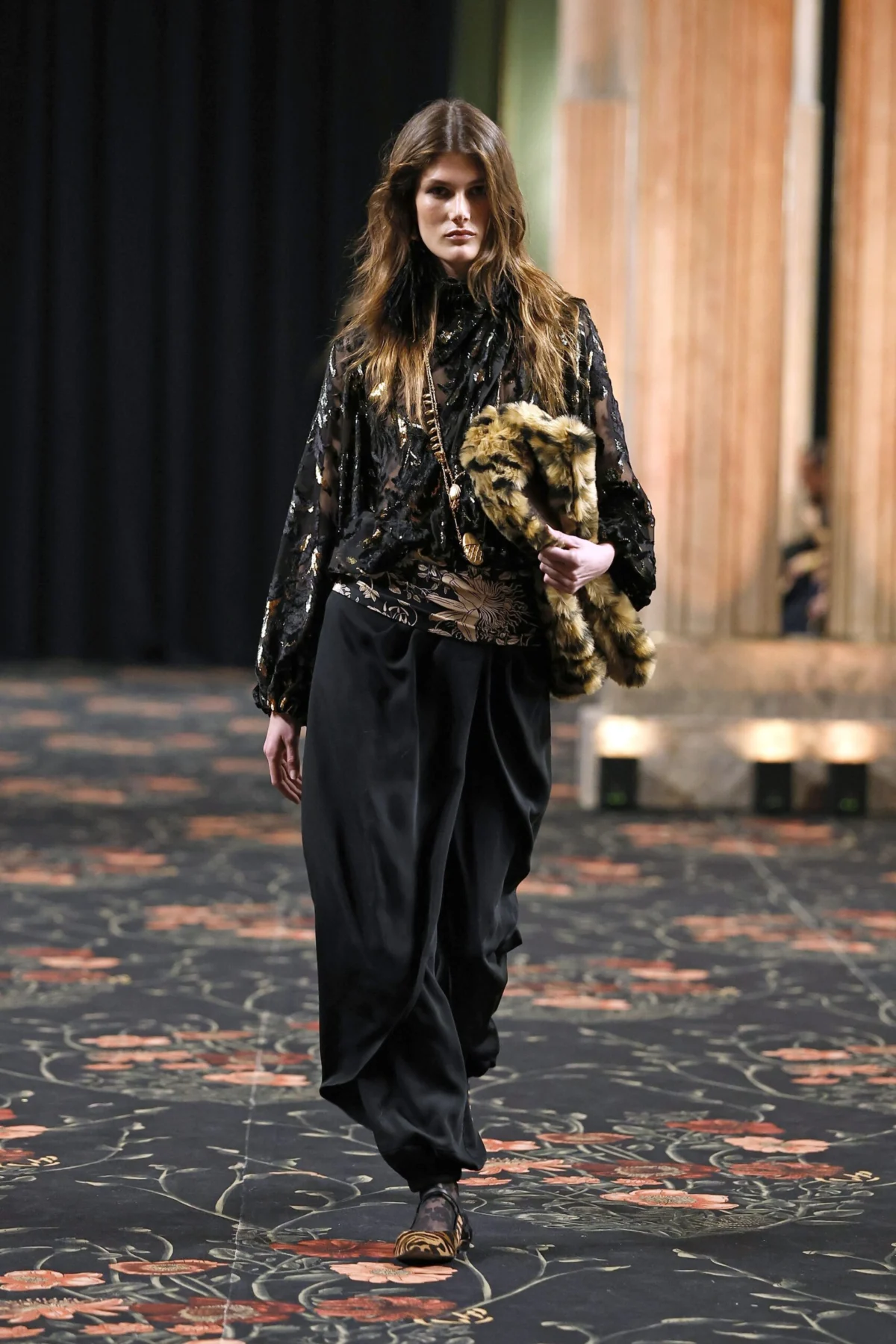
The Colombian fashion house Johanna Ortiz recently unveiled its latest collection, titled Alma, in the Spanish capital of Madrid, marking a significant milestone in the brand’s European expansion and creative evolution. The presentation served as a sophisticated dialogue between the designer’s well-established tropical aesthetic and the historical, theatrical traditions of Spain. By choosing Madrid as the stage for this showcase, Ortiz not only highlighted her brand’s growing international footprint but also paid a nuanced tribute to the cultural ties that bind Latin America and the Iberian Peninsula.
The Alma collection represents a departure from the high-contrast, vibrant prints that first brought Ortiz to global prominence. Instead, the designer opted for a refined, wintry interpretation of luxury that balances the warmth of her home country with the requirements of a global clientele. The event, attended by international fashion critics, buyers, and industry stakeholders, underscored the brand’s ability to translate regional craftsmanship into a universal language of elegance.
A Conceptual Fusion of Heritage and Theatricality
The core inspiration for the Alma collection stems from Ortiz’s lifelong fascination with the trajes de luces—the traditional, ornate costumes worn by Spanish bullfighters. However, the designer was careful to distinguish her creative interest from the controversial spectacle of bullfighting itself, focusing instead on the aesthetic rigor and theatricality of the attire.
"As a child, I was fascinated by trajes de luces," Ortiz remarked during the presentation. "It’s not about bullfighting, but about the theatricality of the moment. I didn’t want to do anything literal, but rather include small nods: reinterpreting that kind of embroidery, emphasizing the shoulders, exploring ruffles—which feel very much ours—while adapting them to that imagery."
This reinterpretation manifested in structural details that paid homage to the matador’s silhouette without becoming costume-like. The emphasis on the shoulder line, achieved through structured tailoring and intricate embellishments, provided a sharp contrast to the soft, voluminous ruffles that have become a Johanna Ortiz signature. By blending the architectural precision of Spanish traditional dress with the fluid femininity of Colombian design, Ortiz created a collection that felt both grounded in history and contemporary in its execution.
Materiality and the Transition to Winter Luxury
One of the primary challenges addressed in the Alma collection was the adaptation of a tropical brand DNA for colder climates. Johanna Ortiz’s headquarters remain in Cali, Colombia—a city known for its consistent, mild temperatures and lack of traditional seasons. To bridge this gap, the collection utilized a sophisticated array of materials, including leather, velvet, and shearling.
The inclusion of heavier fabrics allowed the brand to explore "relaxed luxury" within a wintry context. The runway featured gaucho-style trousers, a nod to the equestrian traditions shared across the Spanish-speaking world, paired with bolero jackets that echoed the structural themes of the collection. Pom-pom belts, a playful yet artisanal touch, were used to cinch dresses, skirts, and coats, providing a tactile element that unified the diverse silhouettes.
Ortiz explained the logic behind this material shift, noting the environmental context of her upbringing. "I come from a country where seasons don’t really exist," she said. "We have mild temperatures and rain all year round, but the seasons don’t truly change. That’s why I like mixing heavier pieces with others that can be worn year-round." This approach ensures the brand’s relevance in major fashion capitals while maintaining the versatility required by modern luxury consumers who travel frequently between climate zones.
Strategic Evolution of the Color Palette
In a move aimed at capturing the "global woman," Ortiz intentionally toned down the saturated hues typically associated with her brand. The Alma collection favored a more restrained palette, moving toward earthy tones, deep blacks, and muted neutrals. This strategic pivot is designed to align with the aesthetic preferences of major markets such as New York and Paris, where winter fashion historically leans toward a more somber and elevated color scheme.
"We see our client as a global woman, and in cities like Paris or New York, colors tend to be quite restrained during winter," Ortiz noted. "So we tried to work those tropical references into the textures rather than the color palette."
By shifting the focus from color to texture, the brand demonstrated a high level of technical maturity. The "tropical" element was maintained through the use of intricate embroidery and fabric manipulation that mimicked organic forms, ensuring the brand’s identity remained intact even without the use of bright floral prints. This evolution reflects a broader trend in the luxury sector where "quiet luxury" and artisanal detail are increasingly valued over overt branding or loud patterns.
The Role of Artisanal Collaboration
Craftsmanship has always been the cornerstone of the Johanna Ortiz brand, and the Alma presentation further solidified this commitment through high-profile collaborations. The collection featured jewelry created by Omar Hurtado, whose work draws inspiration from pre-Colombian motifs. Hurtado’s pieces provided a historical anchor to the collection, linking the modern designs to ancient Latin American artistry.
Furthermore, the brand partnered with the label Moi & Sass for a range of handcrafted leather bags. These collaborations are part of a broader mission by Ortiz to provide a platform for regional expertise. "For us, it’s very important to carefully choose who we collaborate with, but also to give visibility to these crafts and this kind of expertise," the designer stated.
The emphasis on "Made in Colombia" has been a significant driver of the brand’s success. By integrating traditional techniques—such as hand-weaving and specialized embroidery—into high-fashion garments, Ortiz has helped elevate the perception of Colombian manufacturing on the world stage. This commitment to local artisans not only preserves traditional skills but also adds a layer of authenticity and social responsibility that resonates with the contemporary "conscious" consumer.
Chronology of the Johanna Ortiz Brand
The Madrid presentation is the latest chapter in a trajectory that has seen Johanna Ortiz transform from a local Colombian label into a global powerhouse.
- 2003: Johanna Ortiz launches her namesake brand in Cali, Colombia, initially focusing on swimwear and resort wear.
- 2014: The brand gains international attention after being discovered by Lauren Santo Domingo of Moda Operandi. This leads to the brand’s first major international trunk show.
- 2017: The brand expands its distribution to major luxury retailers, including Net-a-Porter, Bergdorf Goodman, and Neiman Marcus.
- 2020: Johanna Ortiz becomes the first Latin American designer to collaborate with the Swedish retail giant H&M, significantly increasing her global brand recognition.
- 2022-2023: The brand focuses on diversifying its offerings, moving beyond the "resort" category into year-round evening wear and accessories.
- Present: The unveiling of the Alma collection in Madrid signals a strategic focus on the European market and a refinement of the brand’s luxury positioning.
Market Context and Economic Impact
The success of Johanna Ortiz is reflective of a larger boom in the Latin American luxury sector. According to market data, the luxury goods market in Latin America is projected to grow significantly over the next five years, driven by a rising middle class and an increasing global appetite for unique, heritage-driven fashion.
Colombia, in particular, has emerged as a hub for textile and fashion exports. In recent years, Colombian fashion exports have exceeded $900 million annually, with the United States and Europe being the primary destinations. Ortiz’s success has paved the way for other Colombian designers—such as Silvia Tcherassi and Esteban Cortázar—to find success in international markets, creating a "halo effect" for the country’s creative industries.
The decision to present in Madrid is also economically significant. Spain serves as a natural gateway for Latin American brands entering the European Union. With Madrid’s luxury market experiencing a post-pandemic resurgence, fueled by both domestic spending and high-end tourism, the city provides an ideal environment for Ortiz to strengthen her ties with European buyers.
Analysis of Implications for the Fashion Industry
The Alma collection serves as a case study in how regional brands can scale globally without losing their cultural soul. Ortiz’s ability to take a highly specific cultural reference—the traje de luces—and translate it into a product that appeals to a woman in Paris or New York is a testament to the power of thoughtful design.
Furthermore, the collection highlights the shifting dynamics of the fashion calendar. By blending seasonal weights and focusing on "trans-seasonal" pieces, Ortiz is responding to a reality where consumers no longer shop strictly by the four-season model. This flexibility is increasingly essential for brands operating in a globalized economy where the "customer" could be in a winter climate one day and a tropical one the next.
The emphasis on artisanal collaboration also points toward a future where luxury is defined by the "human touch" rather than just the brand name. As automated manufacturing becomes more prevalent, the value of hand-crafted, culturally significant items continues to rise. Ortiz’s model of integrating local artisans into a global supply chain provides a blueprint for sustainable and ethical luxury growth.
In conclusion, Johanna Ortiz’s Alma presentation in Madrid was more than just a fashion show; it was a strategic affirmation of the brand’s maturity. By honoring Spanish heritage through a Colombian lens, Ortiz has demonstrated that the future of luxury lies in the intersection of tradition, craftsmanship, and global adaptability. The packed venue in Madrid and the positive reception of the collection suggest that the brand’s trajectory will continue to ascend as it redefines the boundaries of Latin American fashion on the world stage.

0 Comments