
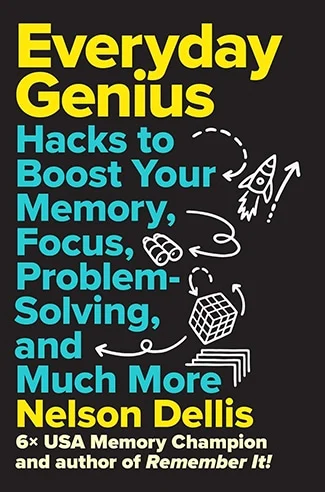
The Evolution of Cognitive Training and the "Everyday Genius" Concept
For decades, the prevailing cultural narrative suggested that intellectual "greatness" was a biological lottery. Figures like Albert Einstein, Nikola Tesla, or Leonardo da Vinci were viewed as outliers with brain structures fundamentally different from the norm. However, the rise of "mental athletes" like Nelson Dellis has challenged this notion. Dellis, who began his journey into memory training following his grandmother’s struggle with Alzheimer’s disease, represents a growing movement of individuals who have utilized neuroplasticity to achieve feats of memory and calculation that appear superhuman to the uninitiated.
Dellis’s work posits that "genius" is a collection of habits and techniques rather than a fixed state of being. By deconstructing the mental processes of high achievers, Dellis provides a framework for what he terms the "everyday genius." This concept focuses on practical, high-level mental skills that can be applied to professional environments, academic pursuits, and daily life management.

Memory as the Foundation of Modern Intelligence
Central to the discussion is the assertion that memory remains the bedrock of all higher-order thinking. In the contemporary era, the "Google Effect"—a phenomenon where the brain fails to store information that is easily accessible online—has led to a perceived decline in internal knowledge retention. Dellis argues that while tools like ChatGPT and search engines provide instant access to data, they do not facilitate the synthesis of ideas that occurs when information is stored within the biological brain.
The "everyday genius" model emphasizes that true creativity and problem-solving require a robust internal database. When a person possesses a deep well of remembered facts, the brain can make spontaneous, cross-disciplinary connections that external tools cannot replicate. To achieve this, Dellis advocates for the use of the "Memory Palace" or Method of Loci—a technique dating back to ancient Greece—which involves visualizing a familiar physical space and "placing" information along a specific path within that space.
Chronology of Memory Sports and the Rise of Nelson Dellis
The field of competitive memory has seen significant growth over the last two decades, evolving from a niche hobby into a globally recognized sport.
- 1991: The first World Memory Championships are held in London, established by Tony Buzan and Raymond Keene.
- Early 2000s: The USA Memory Championship gains traction, highlighting the "mental athlete" as a new category of competitor.
- 2009: Nelson Dellis begins training his memory following his grandmother’s diagnosis, seeking ways to fortify the brain against cognitive decline.
- 2011–2021: Dellis secures six national titles, breaking multiple records for memorizing decks of cards and long strings of digits.
- 2024–2025: Dellis shifts focus toward the democratization of these skills, culminating in the publication of Everyday Genius and his appearance on Podcast 1110.
This timeline illustrates a shift from the pursuit of records for their own sake toward the application of these techniques for broader societal benefit, such as improving focus and lifelong learning.
Supporting Data: The Science of Neuroplasticity and Digital Amnesia
The arguments presented by Dellis are supported by a growing body of neurological research. A study published in the journal Science by researchers at Columbia University found that the expectation of having future access to information (the "Google Effect") significantly reduces the likelihood of that information being encoded in long-term memory.
Conversely, research into "super memorizers" conducted by Stanford University researchers indicates that these individuals do not possess unique brain anatomy. Instead, fMRI scans show increased connectivity in brain regions associated with spatial navigation and visual processing when they are performing memory tasks. This confirms Dellis’s claim: the brain is a muscle that can be rewired through specific mnemonic exercises.

Furthermore, "number sense"—the ability to understand and manipulate quantities mentally—has been linked to higher career earnings and better financial decision-making. Dellis emphasizes that developing a mental "feel" for numbers, such as converting imperial to metric measurements or calculating tips and interest rates on the fly, reduces cognitive load and enhances real-world competency.
Strategies for Focused Reading and Academic Retention
A significant portion of the podcast discussion focuses on the mechanics of focus. In an age of digital distraction, the ability to read deeply is becoming a rare and valuable skill. Dellis suggests that focus is not a passive state but an active engagement with the material.
To improve retention while reading, Dellis recommends:

- Active Interrogation: Frequently pausing to ask questions about the text.
- Visualization: Converting abstract concepts into concrete, often absurd, mental images.
- Spaced Repetition: Reviewing information at increasing intervals to move it from short-term to long-term memory.
These techniques are particularly relevant for students and professionals who must digest large volumes of technical information. By treating reading as a mental sport rather than a passive chore, individuals can significantly increase their "return on investment" for the time spent studying.
Strategic Thinking and Game Theory
The application of "genius" skills extends into the realm of strategy and game theory. Dellis discusses how mental training provides an edge in common games such as Monopoly and Connect Four. While these games involve elements of luck, the "everyday genius" utilizes probability and pattern recognition to tilt the odds in their favor.
For example, in Monopoly, Dellis notes that a "genius" approach involves understanding the statistical likelihood of landing on specific squares (with the Orange and Red properties being the most frequently visited due to their proximity to the "Jail" square). In Connect Four, the focus shifts to spatial awareness and anticipating multiple moves ahead. These examples serve as a microcosm for business and interpersonal strategy, where the ability to see patterns and probabilities leads to superior outcomes.

Esoteric Cognition: Intuition, Dreams, and Remote Viewing
Toward the conclusion of the discussion, the conversation ventures into more speculative areas of human cognition, including intuition and the role of dreams in problem-solving. Dellis posits that intuition is often the result of the brain processing vast amounts of stored data below the level of conscious awareness. By feeding the brain high-quality information through memory training, an individual’s "gut feelings" become more accurate.
The mention of "remote viewing"—a practice historically studied by the CIA during the Stargate Project—serves as a metaphor for the outer limits of mental discipline. While Dellis maintains a grounded approach, he encourages listeners to explore the boundaries of their mental capabilities, suggesting that the human mind is capable of far more than most people assume.
Broader Impact and Implications for the Future
The implications of Dellis’s "Everyday Genius" framework are profound for education and workforce development. As Artificial Intelligence continues to automate routine cognitive tasks, the value of human intelligence will increasingly lie in the ability to synthesize, innovate, and apply deep internal knowledge to complex problems.

Experts in the field of education have reacted to this trend by calling for a return to "classical" mental training combined with modern technology. The consensus among cognitive scientists is that while AI can provide answers, humans must provide the context and the "why." Dellis’s techniques provide the tools for humans to remain competitive in an increasingly automated world.
By shifting the definition of genius from an "innate gift" to a "developed skill set," Dellis provides a roadmap for personal empowerment. The transition from a passive consumer of information to an active "everyday genius" requires discipline and the adoption of specific mental frameworks, but the result is a more capable, focused, and intellectually resilient individual.
In conclusion, Podcast 1110 serves as a call to action for listeners to reclaim their cognitive agency. Through the mastery of memory, the development of number sense, and the cultivation of deep focus, the attributes of the world’s most brilliant minds are revealed not as magic, but as the result of intentional, structured mental practice.

0 Comments