
For nearly a decade, Andrew Mariani, the visionary behind Scribe Winery, harbored a deep conviction that a neglected property a few miles from his esteemed Sonoma vineyard deserved a significant revival. This property, centered around a humble, single-room adobe structure, dates back to 1847, making it one of the most venerable surviving buildings in Northern California. Its historical significance is further amplified by its past role as the residence of a notably unruly mayor, whose tenure was abruptly concluded with the arrival of Union military leader William T. Sherman, tasked with his arrest. Mariani consistently envisioned a future for this storied home, though the precise nature of its transformation remained an evolving concept.

The challenge of revitalizing such a historically significant structure, particularly one designated as a landmark, presented a unique set of architectural and preservationist considerations. The original adobe architecture, a testament to the region’s early building techniques, needed to be respected and preserved. Any intervention would require a delicate balance between honoring the past and introducing modern functionality. The legal and historical protections afforded to such a building meant that external alterations were severely restricted, necessitating an approach that was both innovative and sensitive to the existing fabric of the structure.
Mariani engaged with Leigh Salem of the multidisciplinary design firm Post Company to explore the property’s potential. This collaboration, as Salem describes, eschewed a traditional design process, evolving organically through a series of considerations and adaptations. Initially, Mariani contemplated the adobe as a personal residence. However, as his family expanded to include three children, this aspiration became logistically impractical. The subsequent four-year renovation, culminating in 2025, ultimately yielded a highly adaptable space. This transformed property now serves a dual purpose: a sophisticated hospitality venue for Scribe Winery events and a comfortable guest retreat for extended family, seamlessly integrating historical reverence with contemporary comfort and utility.

The design philosophy centered on maintaining the integrity of the original structure. "Our approach to the renovation was to keep the historic section as honest as possible," Mariani stated. "Basically, to do the minimum to it, to maintain its palette and texture and beauty." This commitment to preservation posed significant challenges for integrating modern amenities and expanding the usable space.
Architectural Innovation Amidst Preservation Constraints
The landmarked status of the adobe imposed strict limitations on any alterations to its original walls. Traditional methods of attaching new structures were consequently prohibited. Post Company’s solution was to design a discreet, U-shaped wing that would be situated behind the existing adobe. This new addition was meticulously planned to be entirely concealed from street view, thus preserving the historic facade’s integrity.

"The building is fully independent and preserved," Salem explained, highlighting the innovative connection method. Instead of a conventional foundation or direct attachment, a substantial structural beam was integrated, precisely aligned with a newly installed skylight. This beam serves as the sole point of connection between the historic adobe and the modern wing, creating a visually striking, albeit subtle, seam that underscores the sensitive integration of old and new. This approach ensured that the venerable adobe structure remained untouched, with the new construction acting as a respectful, adjacent complement rather than an intrusive extension.
The new wing, featuring two bedrooms and three bathrooms, was designed to extend the property’s functionality without compromising the historical narrative. This thoughtful expansion allowed for modern living amenities while ensuring that the original adobe remained the focal point, its historical significance amplified by its protected status and its central role in the property’s new purpose.

A Fusion of History and Hospitality
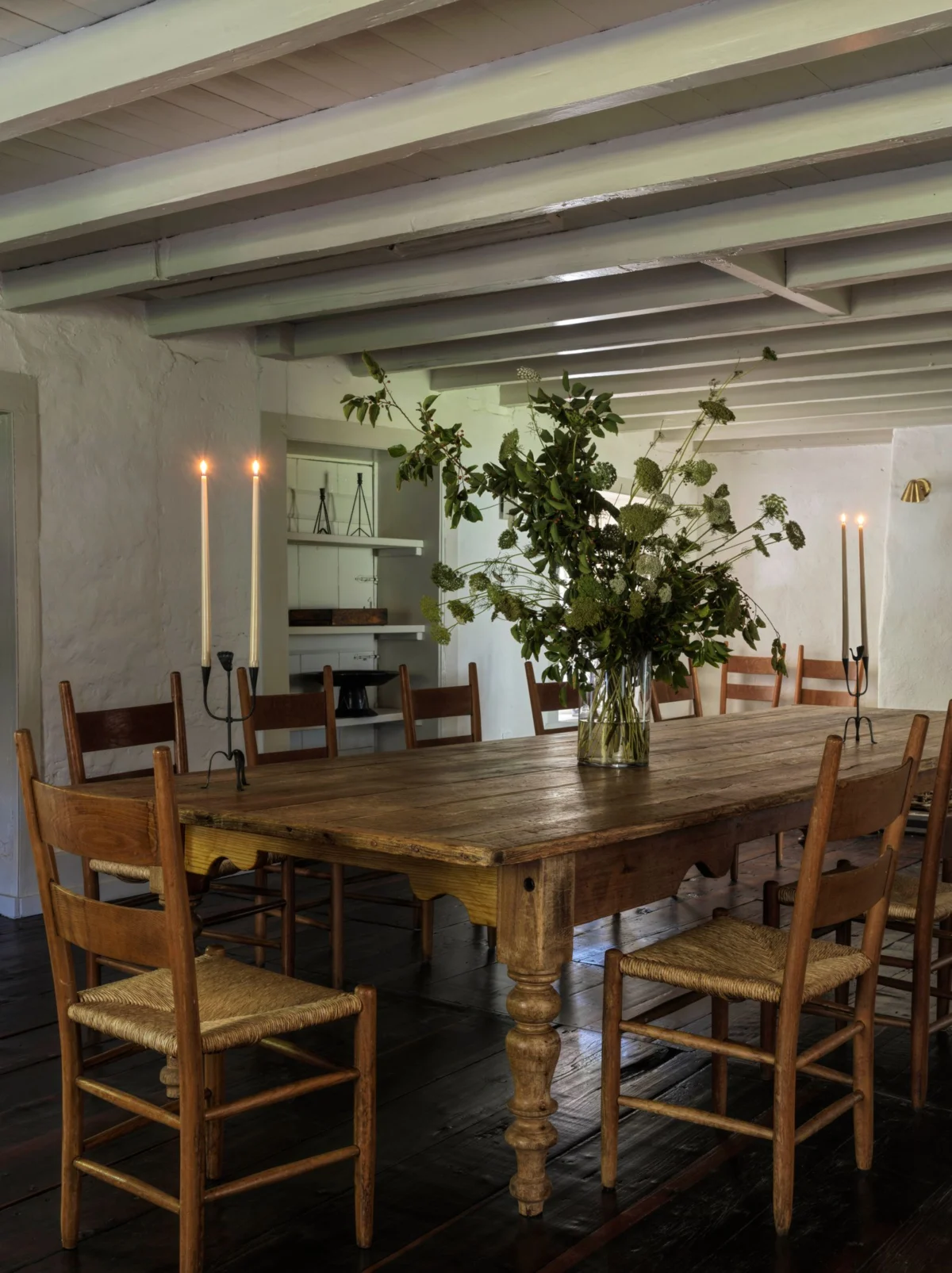
The original 1847 adobe structure now serves as the heart of the property’s hospitality function, particularly for intimate dining experiences. The interior of this historic section has been deliberately kept minimal, almost monastic, to allow the original materials and architectural character to take precedence. The focal point of this space is an expansive, thirteen-foot-long vintage dining table, sourced from the renowned Round Top Antiques Fair in Texas. This table is surrounded by an eclectic collection of chairs, originally from a Dutch church, which were acquired through Amsterdam Modern.
The ambiance within the adobe dining area is intentionally curated to enhance the sense of history and intimacy. There is a deliberate absence of overhead lighting. Instead, the space is illuminated by wall sconces and the warm glow of candlelight. This atmospheric lighting choice aims to foster a moody, inviting environment, ensuring that the focus remains firmly on the shared experience of dining and conversation. The wall sconces themselves are by Hector Finch, adding another layer of considered design to the historical setting.

Echoes of the Past, Embracing the Present
The attic space within the original adobe has been transformed into a cozy, tucked-away lounge. This area proudly showcases its historical lineage, with original framing still visible and remnants of early insulation, including layers of centuries-old newspapers, still lodged within the walls. This intimate space offers a tangible connection to the building’s past, providing a unique historical context for guests. The decor in this lounge is a thoughtful selection of vintage and contemporary pieces, including a Noguchi Akari floor lamp, a leather sofa from Living Divani, and a coffee table from Post Company’s collaboration with Roll & Hill. This blend of old and new elements within the attic lounge further reinforces the property’s narrative of continuity and thoughtful adaptation.
The new wing, in contrast, provides modern living spaces while subtly deferring to the historic adobe. Salem emphasized that "everything is in support of allowing you to enjoy the history of that original space." The bedrooms are designed with deliberate restraint, featuring soft furnishings that maintain a sense of calm and simplicity.

The kitchen, while equipped with modern conveniences, incorporates English Shaker cabinetry. This choice, though perhaps unexpected, was made to "play off of the history" of the space, according to Salem. The handcrafted details of the cabinetry, including visible brushstrokes from its hand-painted finish, lend a sense of enduring quality that harmonizes with the historical context of the adobe. The kitchen also features cabinetry from Plain English, known for its artisanal quality, and pendant lighting by Devol, adding contemporary touches.
A Contemporary Californian Aesthetic
The exterior of the new addition presents a distinctly Californian aesthetic, characterized by modern lines, steel-framed picture windows, and aged cedar siding. This contemporary design stands in thoughtful contrast to the ancient adobe, yet it is integrated in a way that complements rather than competes with the historic structure. The back courtyard offers visitors a full perspective of Post Company’s addition, revealing how the modern wing frames the adobe, positioning it as the project’s quiet center of gravity. This deliberate architectural choreography allows the historical significance of the adobe to remain paramount, with the new construction serving to enhance its presence and provide functional support.

The property’s location in Sonoma, a region renowned for its viticulture and historical significance, adds another layer to its story. Sonoma played a crucial role in the mid-19th century, particularly during the tumultuous period of California’s transition from Mexican to American governance. The adobe, having stood witness to events like the Bear Flag Revolt, carries within its walls a palpable sense of this pivotal history. This historical backdrop imbues the renovation with an added layer of responsibility and resonance, ensuring that the preservation efforts honor not just the building but the broader historical narrative it represents.
A Legacy of Design and Preservation
The successful revitalization of the 1847 Sonoma adobe by Andrew Mariani and Post Company stands as a compelling example of how historical structures can be thoughtfully integrated into contemporary life. By prioritizing preservation and employing innovative architectural solutions, the project has transformed a near-derelict building into a functional and aesthetically significant space. The dual role of the property as a hospitality venue for Scribe Winery and a private retreat underscores the enduring appeal of historical sites when approached with sensitivity and a clear vision. The project not only safeguards a piece of Northern California’s architectural heritage but also creates a unique destination that offers guests an immersive experience, bridging the past and the present in a harmonious and elegant manner. The careful selection of furnishings, from the vintage dining table to the contemporary pieces in the newer wing, reflects a deep appreciation for craftsmanship and timeless design, ensuring that the adobe’s second act is as distinguished as its first.

0 Comments